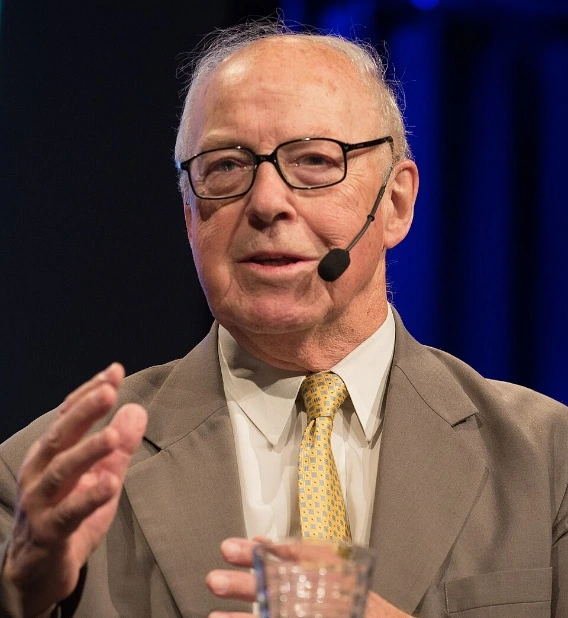
BLIX, Hans Mårten
Swedish Foreign Minister and third Director General of the International Atomic Energy Agency (IAEA) 1981-1997
By Malcolm Byrne · Version 29 October 2026
Was born in Uppsala, Sweden on 28 June 1928. He is the son of Gunnar Blix, professor of medicine, and Hertha Wiberg, nurse. On 17 March 1962 he married Eva Margareta Kettis, later Swedish diplomat and Ambassador for Arctic and Antarctic Affairs, with whom he has two sons.
Biography
Blix’s father followed in his own father’s footsteps, a medical professor and rector of Lund University, by becoming an eminent professor of medicine and vice rector of Uppsala University. Blix and his elder brother and sister grew up in what he described as a warm and comfortable environment with parents who held scientific-rational, yet empathetic, views and a moderately liberal political outlook. Like increasing numbers of Swedes from the interwar period, they had a ‘very tepid’ attitude toward religion. At school, Blix recalled being ‘boisterous’ and requiring regular disciplinary ‘pruning’ until about the age of fourteen, when he discovered the tempering influence of literature, history and philosophy (Biographical note provided to author by Blix, 2025). He credits certain teachers and family friends for encouraging his early intellectual growth. From his father and a secondary school biology instructor he developed a lifelong love of nature and appreciation for the environment. Blix’s interest in law and international relations was substantially shaped by the Second World War, which began when he was eleven and ended when he was seventeen. Sweden’s isolation and the devastation across Europe awakened in him both a worldly curiosity and a desire to build paths toward a durable peace. Starting in 1946, he studied law as an undergraduate at Uppsala University where he began to explore the concept of extending the ‘fabric of international law’ as an essential means to promoting a fair and stable world order (Interview with author, 17 February 2025). While studying he became active in political circles, joining the youth wing of the moderately inclined Liberal Party. He also indulged a passion for theater, directing several amateur productions.
The founding of the United Nations (UN) in 1945 offered Blix an institutional platform to further his ideas on international affairs. In 1950 he won a UN essay contest for his entry ‘Has the rule of unanimity prevented the U.N. from functioning in the security field?’. The prize, one month at UN headquarters in New York, was a formative experience, coming at an eventful time in the Cold War. After receiving his undergraduate degree in law in Uppsala (1951) he enrolled at Cambridge University in the United Kingdom, eventually deciding to pursue a doctorate in international law. For two years he studied at Columbia University in the United States (US) (under the supervision of Hersch Lauterpacht) and conducted research for prominent diplomat and scholar Philip Jessup. After an additional period of thesis writing, he received his PhD from Cambridge University, followed by a doctoral degree in legal studies from Stockholm University. In 1960 he published his Cambridge doctoral dissertation under the title Treaty-Making Power and accepted an appointment as Associate Professor of international law at Stockholm University, intending to follow his father into academia.
While working at the university he continued to be active in politics but was not yet fully clear about a career path. One of his activities was providing part-time legal advice to the Foreign Ministry. He became known to Sweden’s venerable Foreign Minister, Östen Undén, who appointed him to join the Swedish Delegation to the 18-Nation Disarmament Conference (Geneva, 1962), headed by Swedish diplomat Alva Myrdal. In 1963 he became full-time adviser to the Ministry, serving until 1976. One of his earliest assignments during this instructive period was the establishment of the so-called Friendly Relations Committee at the UN, for which he served as inaugural rapporteur in 1964 and continued to be involved until the General Assembly adopted its final Declaration on the Principles of International Law Concerning Friendly Relations and Cooperation among States (October 1970). The challenge for Western delegations, Blix recalled, was to prevent the Soviet bloc from twisting basic principles of the UN Charter, such as non-intervention and the non-use of force, to their own ideological ends. During the same period Blix worked with the UN Outer Space Committee, helping to elaborate the 1967 Outer Space Treaty.
His next assignment was as a Swedish representative to the UN Conference on the Law of Treaties (1968-1969). Although not considered a high-profile activity, he took pride in helping to formalize the treaty text, which he characterized as a tremendously important development in basic international law. He played a prominent role in the groundbreaking UN Conference on the Human Environment in Stockholm (June 1972). He wrote the first draft of the final, non-binding declaration and helped to steer it through to adoption. This heightened the global visibility of environmental issues. Studying the effects of acid rain led Blix to see nuclear power as a desirable energy source. Two other noteworthy experiences took place during his UN tenure in the 1970s. In the wake of the Vietnam War he became deeply engaged in drafting protocols on the modernization of the laws of war. One debate was over banning so-called particularly injurious weapons, including napalm and high-velocity projectiles. His work on establishing the legal framework for an agreement led to the 1980 adoption of the landmark Convention on Certain Conventional Weapons. During the same period, Blix participated as a legal and policy adviser to the Swedish delegation at the 1975 Helsinki Conference, which made use of his experience from the Friendly Relations Committee, which dealt with similar issues. Blix credits his time at the UN with teaching him the ins-and-outs of international organizations, deepening his legal knowledge and negotiating skills and, not least, introducing him to numerous diplomats and political personalities he would cross paths with at key later points in his career.
In 1976 Blix entered the political stratum in Sweden after national elections led to the ouster of the Social Democrats and the formation of a non-Socialist government for the first time since 1932. A lifelong member of the Liberal Party, one of the coalition parties, Blix was offered the position of Under-Secretary of State for development assistance. Although it was at the highest non-cabinet level at the Foreign Ministry, Blix initially hesitated. However, the opportunity to work on a top foreign policy priority for Sweden was appealing, as was the chance to broaden his expertise. Nuclear energy was a major issue for voters in the 1976 general elections, and it resurfaced in 1978 when the Prime Minister failed to maintain coalition unity on the matter and had to resign. Blix’s Liberal Party formed a new government under Ola Ullsten, who picked the respected technocrat as Foreign Minister. But in the following general elections just a year later, the non-Socialist coalition reclaimed its parliamentary majority, forcing Ullsten to relinquish the premiership. Ullsten in turn claimed the Foreign Minister post for himself, but reinstated Blix as Under-Secretary of State. Blix’s willingness to accept his old job was a sign that he saw himself more as a civil servant, rather than a politician. Although he was formally in charge of development assistance, Blix took on an assignment that would thrust him into the heart of the country’s nuclear debate. In the aftermath of the 1979 Three Mile Island accident in the US, which involved a partial core meltdown of the nuclear power plant’s reactor, Sweden held a national referendum in 1980 on whether to pursue nuclear power. Blix was named leader of the Liberal Party’s campaign (in tandem with the Social Democrats) in favor of developing twelve nuclear reactors for a 30-year period, a middle line between abolishing the program and continuing it for an unspecified period.
Blix credits his involvement in the nuclear referendum with stimulating his interest in applying for the post of Director General of the International Atomic Energy Agency (IAEA) following the retirement in 1981 of Sigvard Eklund, who had been in office since 1961. At first, Blix was put off by the Agency’s ‘terribly specialized mandate’ in addition to his relative lack of experience in the field (A Somewhat-Expanded Curriculum Vitae, April 2020, provided to author by Blix). However, he shared IAEA’s commitment to promoting nuclear energy. He also recognized that the credible safeguarding of nuclear facilities was crucial both in its own right and, from his experience as a negotiator, as a condition for reaching disarmament agreements. IAEA’s lower-profile programs, sharing technology with less developed countries, eradicating insects and other medical and agricultural activities also held an appeal for him. He won the election, in September 1981, after a deadlock ensued over several internal candidates. In his favor he had the support of the US, by far the agency’s biggest financial supporter, as well as the backing of other members based on his reputation in the international community. Although a Swede replacing another Swede was an obstacle for members from the Global South, his home country had several positive attributes, notably its standing as a neutral state with a stake in nuclear energy and a history of generous foreign assistance to the developing world. Blix took office on 1 December 1981.
The early 1980s were a turbulent time. The Cold War had entered a new phase of antagonism following the Soviet invasion of Afghanistan and the election of US President Ronald Reagan, who called the Soviet Union an Evil Empire. Apart from the superpower rivalry, the Global South was in a state of upheaval. Anti-Western movements were on the rise, asserting their independence from the big powers, sometimes violently (as in Iran and Nicaragua). Political Islam emerged as a new phenomenon, and the Arab Israeli conflict was about to become even more chaotic. These developments affected the dynamics within many international organizations, even the IAEA which was ostensibly apolitical, and it was Blix’s job to find ways to manage the consequences. His first political crisis grew out of the June 1981 Israeli attack on the Osirak nuclear reactor in Iraq. Arab member states sought to punish Israel, finally resorting to a procedural maneuver at the September 1982 General Conference to reject Israel’s delegation credentials. In response, the US walked out and formally suspended its participation in and financial support for the IAEA. The incident was a blow to the Agency’s credibility, and a permanent US pullout would cripple it financially. Over the following months Blix engaged in extensive diplomacy with all sides, eventually helping to resolve the crisis without lasting harm. The US resumed its participation in early 1983.
Blix’s next major test was the explosion at the Soviet nuclear plant in Chernobyl on 26 April 1986. Once again, the crisis called the Agency’s authority and credibility as a nuclear watchdog into question. Blix was the first Western official to visit the site in early May. He and the Agency earned praise for the promptness and effectiveness of their response. In the short term the IAEA guided the drafting of new international conventions on early notification and emergency assistance in the event of future accidents. At the same time critics alleged that the IAEA was overly concerned about protecting the nuclear industry, downplaying the incident’s severity and taking too soft an approach to the Soviets. Blix later defended the Agency’s methods, including not confronting Moscow about the initial opacity surrounding the disaster. He argued that respectful diplomacy rather than confrontation was the best long-term tool, vital for encouraging trust, cooperation and transparency. Overall, the Agency was given good marks for its actions and the new agreements served to focus attention on the need for greater IAEA authority in dealing with recalcitrant member states. However, the next crisis would show just how limited the Agency’s powers were when it came to states that chose to be uncooperative.
After the conclusion of Operation Desert Storm, the US-led military operation to expel invading Iraqi forces from Kuwait, the UN Security Council passed Resolution 687 in April 1991, requiring Iraq to disclose and eliminate all nuclear, biological, chemical and long-range ballistic missile capabilities as a condition of the ceasefire. When international inspectors entered the country in mid-1991, they uncovered a vast weapon of mass destruction (WMD) apparatus that Baghdad had hidden for years. Reactions to the discoveries were harsh, particularly from the American side. Blix acknowledged the criticisms but countered that Western intelligence agencies, equipped with the most advanced surveillance tools, had also failed to uncover Saddam Hussein’s secret activities. Furthermore, prior to 1991, IAEA member states, including the US, had refused to grant the Agency intelligence-gathering powers or even the legal right to conduct so-called ‘anytime, anywhere’ surprise inspections of undeclared sites. All the IAEA could do was inspect what states declared. Blix spent much of the decade trying to bolster the Agency’s capabilities and recoup its reputation.
Perhaps Blix’s biggest achievement in this regard was overseeing the formulation of the Model Additional Protocol (MAP) to the Treaty on the Non-Proliferation of Nuclear Weapons (NPT), the core legal mechanism for preventing the spread of nuclear weapons and promoting disarmament which entered into force in 1970. The new Protocol, initiated in 1993 as the 93+2 Program to strengthen and modernize international nuclear safeguards, expanded the IAEA’s legal authority to use satellite imagery, seize intelligence data and demand access to undeclared locations. While the Iraq inspections were in full swing, North Korea’s nuclear program arose as another focus of global concern. An IAEA member since 1974 and a signatory of the NPT since 1985, North Korea had not signed onto the Comprehensive Safeguards Agreement until April 1992, whereupon it began submitting the obligatory reports to the IAEA. However, inspectors quickly found that the reports contained gaps and discrepancies. Satellite imagery showed that North Korea had built two undeclared nuclear waste stores. In response, Blix demanded a rare Special Inspection, which North Korea rejected, leading the IAEA in 1993 to declare the country in breach of its agreements. North Korea subsequently withdrew from the Agency in 1994. The crisis persisted well beyond Blix’s departure in 1997, but his firm actions earned praise, even from American officials who had criticized him for being soft on Iraq.
Blix and the IAEA faced several other tests from so-called threshold states. India and Pakistan, for example, neither of which had acceded to the NPT, posed a constant threat to regional peace. Blix consulted frequently with each side, urging adherence to at least the principles of non-proliferation and risk reduction. Israel was another constant headache. As was the case with India and Pakistan, the Israeli refusal to sign the NPT deprived Blix of the legal authority to inspect the country’s undeclared, but widely presumed, nuclear facilities at Dimona. Nevertheless, Blix regularly attempted to fulfill IAEA mandates, urging Israel to accept full-scope safeguards. He also advocated for a Middle East Zone Free of Weapons of Mass Destruction, arguing that Israel’s nuclear opacity was a destabilizing factor that invited neighboring states to seek counter-capabilities. Blix had more success with nuclear-weapon-free zones in other parts of the world. During his tenure, new zones were established (covering South Pacific, Southeast Asia and Africa), while existing zones in Latin America (since 1967) and Antarctica (since 1959) gained broader compliance and regional coverage. Blix was personally recognized for his and the IAEA’s contributions to some of these milestones. The presidents of Argentina and Brazil invited him to the 1990 signing of their Declaration on Common Nuclear Policy. He also attended the signing ceremony for the Pelindaba Treaty, the African Nuclear-Weapon-Free Zone Treaty, in Cairo, Egypt in 1996.
Global developments during Blix’s eventful term often spilled over into the nonproliferation and disarmament spheres. For example, after the Soviet Union’s collapse in 1991 Blix had the responsibility to oversee the IAEA’s mandate to persuade the governments of the Newly Independent States, specifically Belarus, Kazakhstan and Ukraine, to sign onto global non-proliferation norms and ensure that they transitioned into non-nuclear states. Another case was the Republic of South Africa under President Fredrik Willem de Klerk. After Pretoria signed the NPT in July 1991, the government agreed to an audit of the country’s nuclear material. During that audit, in March 1993, De Klerk publicly acknowledged for political reasons that South Africa had secretly built and dismantled six nuclear warheads prior to joining the Treaty. Blix deployed specialized teams of inspectors and weapons experts to execute an unprecedented verification protocol, and, after more than twenty missions, the IAEA was able to resolve earlier discrepancies and verify that all fissile material was accounted for. Blix could certify that South Africa’s nuclear weapons program had been fully dismantled. The case proved that a country could reverse a covert nuclear program and be effectively verified by international inspectors.
Libya was another challenge for the IAEA, even though it operated just a single known nuclear site. Under pre-1990s protocols, Libya was subject only to routine safeguards checks of declared facilities. Inspectors were therefore unable to detect the country's clandestine activities, begun in the late 1980s, to procure centrifuge technology and weapons designs from the notorious black-market operation run by Pakistani nuclear scientist Abdul Qadeer Khan. The IAEA worked to ensure that declared research materials at the Soviet-built Tajoura Nuclear Research Centre remained safeguarded. Only after Muammar Qaddafi, facing crippling economic sanctions and other difficulties, decided to abandon his WMD ambitions in December 2003 was the IAEA under Mohamed ElBaradei able to fully uncover and dismantle the program.
Along with the MAP, another notable structural change to the non-proliferation system Blix contributed to was the NPT’s indefinite extension in 1995. Since its entry into force in 1970, the NPT has been of foundational importance to the IAEA. It imparts both legal authority and political legitimacy to the Agency, while the IAEA in turn provides the verification mechanism that is vital for the Treaty’s credibility. For proponents of the NPT, approval of the Treaty’s indefinite continuation at the May 1995 Review and Extension Conference was an achievement for which Blix deserves credit. However, the idea generated considerable opposition, mainly from Non-Aligned Movement members who objected to the perpetuation of ‘nuclear apartheid’ and the refusal of nuclear-weapon states to fulfill their obligation under the Treaty to disarm. Once achieved, however, supporters saw the decision as a vote of confidence in the NPT framework and a reflection of improvements made to IAEA safeguards.
Beyond non-proliferation, key focuses of interest for Blix and the IAEA were the environment and sustainable development. On many occasions, notably at the 1992 Rio Earth Summit, Blix advocated for nuclear energy as a clean, low-carbon alternative to fossil fuels for combatting global warming. During his directorship, the IAEA managed radioactive waste guidelines under Agenda 21, leading to the 1997 Joint Convention on Spent Fuel Management. Blix also expanded technical aid to developing states using nuclear techniques for groundwater mapping, agriculture and pest control. Despite post-Chernobyl public skepticism over waste risks and nuclear energy overall, he successfully elevated the IAEA’s role in the arena of global sustainability.
After four elected terms as Director General, Blix stepped down on 30 November 1997, handing over the IAEA’s leadership to Egyptian Mohamed ElBaradei. Blix’s tenure was widely seen as remarkably successful. Many viewed him as an experienced, capable diplomat who brought a balanced, independent and principled approach to the position. After the initial fallout over Iraq in 1991, he earned praise for acknowledging past problems, strengthening the Agency’s methods and raising its stature as an international organization. Within the IAEA, Blix was able to overcome initial doubts over an international lawyer leading a technical agency. The IAEA gained twenty new members, including China. From published accounts and interviews, Blix gained broad appreciation for his open management style and the respect he demonstrated for staff, from shielding inspectors from international pressure to taking lunch in the cafeteria.
For the next two years, Blix was an active lecturer and writer on international law, disarmament and global security. Then, at age 71, he was asked to take on a new post at the UN, focusing once again on the conundrum of Iraq. This would be the most contentious assignment of his career. In March 2000 he was installed as Executive Chairman of the UN Monitoring, Verification and Inspection Commission (UNMOVIC), established under Security Council Resolution 1284. UNMOVIC’s mandate was to verify Iraq’s obligations, imposed in 1991, to disclose and dismantle its chemical, biological and long-range ballistic missile programs, and to establish an ongoing monitoring system for the country. Over the next three years Blix and ElBaradei, whose IAEA mandate concerned the nuclear file, attempted to fulfill their duties despite Iraq’s refusal to allow inspectors into the country. On the political level they faced a different kind of challenge in the form of mounting US pressure to declare Iraq in violation of UN resolutions. President George W. Bush and hardliners in his administration fundamentally distrusted Saddam Hussein and believed that he would stymie outside inspectors while continuing to pursue various WMD activities. They were especially skeptical about Blix, recalling the allegations of softness against him from 1991. Their publicly expressed view was that the only way to fully disarm Iraq was by force. But since President Bush had decided to seek UN backing for an invasion, using the purported existence of WMD as justification, the US had effectively conditioned its next steps on a finding of noncompliance by the inspectors.
Blix and ElBaradei resisted public lobbying and private arm-twisting, which originated at the highest levels of the American and British governments. They insisted that they would report only what the inspectors observed. In January 2003 Blix seemed to offer hope to proponents of military action when he reported to the Security Council that Iraq lacked ‘genuine acceptance’ of disarmament. However, in early March the message was quite different, noting ‘proactive’ cooperation on Baghdad’s part and echoing ElBaradei’s conclusion that there was simply no evidence of ongoing WMD activities in Iraq. Unwilling to accept the implications of those findings and recognizing that the US did not have the votes for an additional UN resolution, Bush abandoned that effort and gave the order to invade Iraq. Military operations commenced on 19 March.
Blix left UNMOVIC at the end of June 2003. His resistance gained him worldwide acclaim, including dozens of prestigious awards, even though his efforts could not prevent the occupation of Iraq that he and others had predicted. In 2004 he published a memoir about that episode and accepted a position as Chair of the independent International Commission on Weapons of Mass Destruction. In 2025 he published another volume of private messages addressed to his son about his UNMOVIC experience. He has remained a steadfast critic of the 2003 invasion, labeling it an illegal act that violated the UN Charter and undermined the international legal order. Blix continues to write, lecture and participate actively in public discourse on international affairs well into his 90s. In 2023 he published A Farewell to Wars, a summation of decades of observation and analysis of international military conflict and its causes.
Archives
- Hans Blix’s Archives in Uppsala University Library, Sweden: Alvin - Hans Blix's archives
- Hans Blix Collection in IAEA Historical Archives, Vienna International Centre, Austria: IAEA Archives | Details | Hans Blix Collection
Publications
- Treaty-Making Power, New York 1960
- ‘International Law and the Nuclear Fuel Cycle’ in The Australian Quarterly, 56/2, 1984, 163-171
- ‘Verification of Nuclear Nonproliferation: The Lesson of Iraq’ in Washington Quarterly, 15/4, 1992, 57-65
- ‘Sustainable Development and Nuclear Power’ in Journal of Nuclear Science and Technology, 34/2, 1997, 97-101
- Disarming Iraq, New York 2004
- Weapons of Terror: Freeing the World of Nuclear, Biological and Chemical Arms, Stockholm 2006
- Why Nuclear Disarmament Matters, Boston 2008
- A Farewell to Wars: The Growing Restraints on the Interstate Use of Force, Cambridge 2023
- The Hans Blix War Diaries, 2000-2003, Cambridge 2025
Literature
- D. Fischer, History of the International Atomic Energy Agency: The First Forty Years, Vienna 1997
- ‘A World Without WMDs? Modern Challenges to Nuclear Non-Proliferation’ in Harvard International Review, Fall 1997, 78-81 (Interview)
- BBC, Profile: Hans Blix, 8 February 2004, http://news.bbc.co.uk/2/hi/europe/2268819.stm
- W. Wark, ‘Disarming Iraq’ in International Journal, 60/1, 2005, 282-285
- ‘Interview with Hans Blix, Chairman of the WMD Commission’ in Fletcher Forum of World Affairs, 30/1, 2006, 81-91
- M. Elbaradei, The Age of Deception: Nuclear Diplomacy in Treacherous Times, New York 2011
- ‘Hans Blix: A Diplomatic Life’ in openDemocracy, 4 January 2016
- E. Röhrlich, Inspectors for Peace: A History of the International Atomic Energy Agency, Baltimore 2022
- D. Fleck, ‘A Farewell to Wars: The Growing Restraints on the Interstate Use of Force by Hans Blix’ in Journal of Conflict & Security Law, 29/1, 2024, 185-191
- ‘Hans Blix: Swedish Diplomat’ in Encyclopedia Brittanica, 24 June 2026, see www.britannica.com/biography/Hans-Blix
(all websites approached 5 August 2026)
How to cite
Malcolm Byrne, 'Blix, Hans Mårten' in IO BIO, Biographical Dictionary of Secretaries-General of International Organizations, edited by Bob Reinalda, Kent J. Kille, Jaci L. Eisenberg, Ellen Ravndal and Dawisson Belém Lopes. https://doi.org/10.5281/zenodo.23923882
Text © the author(s) and IO BIO, licensed under CC BY-NC-ND 4.0. The portrait is excluded and remains under the rights of its credited source. We have tried to trace the rights holder to obtain permission for the use of the portrait, but contact us in case we have failed.