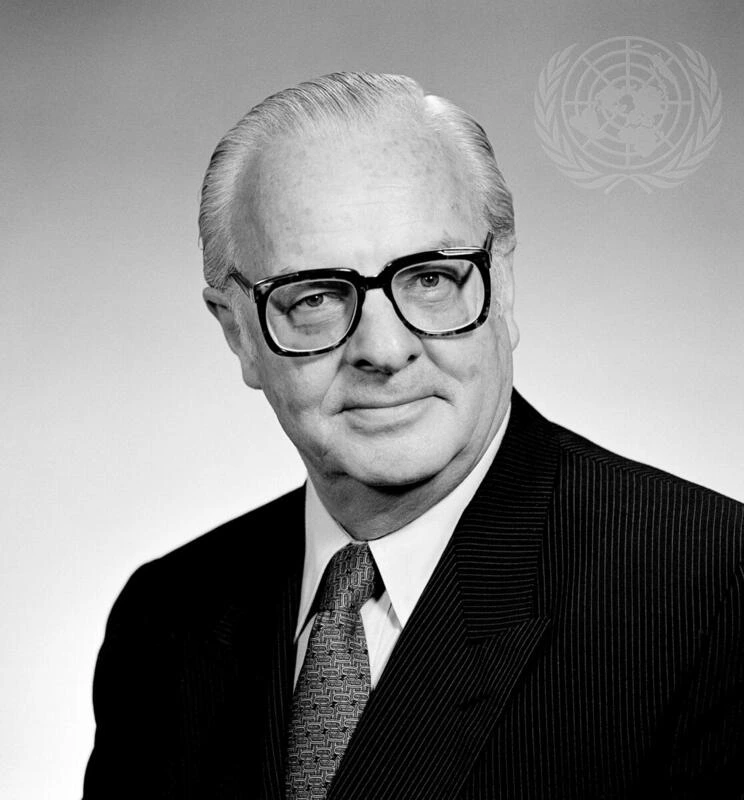
BOGSCH, Árpád
Hungarian-born American lawyer and second Director General of the World Intellectual Property Organization (WIPO) 1973-1997
By Gusztáv D. Kecskés · Version 6 October 2026
Was born 24 February 1919 in Budapest, Hungary and died 19 September 2004 in Geneva, Switzerland. He was the son of Árpád Bogsch, lawyer, and Emília Taborsky. On 11 April 1942 he married Paula Takáts, with whom he had one daughter and one son. After her death in 1987 he married Adèle Fankhauser, his former secretary, on 8 January 1994.
Biography
Bogsch was born into a prosperous Budapest middle-class family of Zipser (Szepes Saxon) descent, in which a German linguistic heritage coexisted with a firmly Hungarian identity. His father, a lawyer who worked up to 16 hours a day and in 1937 received the title of Chief Government Counsellor from Regent Miklós Horthy, remained, as Bogsch later wrote, a ‘lighthouse’ for his own career (Bogsch 2004: 169). His mother, whose cheerful nature and deep Catholic faith he recalled with lifelong devotion, ran the household and remained his closest confidante. Even as an international official he regularly reported to her about his missions by letter and telephone. His parents attached exceptional importance to education. Besides the German he learnt at home, Bogsch acquired English and French to a high standard. From the age of 16 he spent his summers abroad with the express purpose of learning languages. He ended up speaking six languages fluently (also Italian and Spanish) and had a good command of Latin. He completed his secondary education with distinction in 1937 at the Fasori Lutheran Gymnasium, the renowned Budapest school that produced several Nobel laureates and to which he remained attached all his life, including presiding (starting in 1988) over the Geneva-based association of former pupils that supported the school’s post-Communist revival. In 1942 he obtained a doctorate in law summa cum laude at the Péter Pázmány University in Budapest and started work in his father’s law office, which also handled international cases. Called up for military service in November 1944, he served until the end of the war and did so out of a sense of duty. Although he already judged the military situation hopeless by the autumn of 1944 and the war lost from the point of view of Germany, Hungary’s ally, he decided that he would not become a deserter, as he wrote in his memoirs (Bogsch 2004: 7).
Bogsch’s speciality found him in the spring of 1945, when he joined the legal department of Hungarian Radio and began to deal with copyright, the field that would accompany him for the rest of his life. Through the International Broadcasting Organization he took part, in 1946-1947, in preparing the broadcasters’ position on the revision of the Berne Convention for the Protection of Literary and Artistic Works of 1886. As a member of the Hungarian delegation to the diplomatic conference held in Brussels, Belgium in 1947 he met three men who would prove to be decisive for his career: François Hepp, Head of the Copyright Division of the United Nations (UN) Educational, Scientific and Cultural Organization (UNESCO), Arthur Fischer, the United States (US) Registrar of Copyrights, and the Dutch lawyer Georg Bodenhausen. Having foreseen the Sovietization of Hungary and the fate awaiting the middle class, Bogsch decided, before his official mission to Brussels in July 1948, not to return home. His wife and children followed him illegally in January 1949. Although Bogsch’s career advanced without interruption, he later confessed that the pain of emigration never left him. The émigré, he said, ‘becomes socially a nought’ and loses everything his forebears had achieved in the country left behind (Bogsch 2004: 218). Through Hepp’s intervention he worked from 1948 to 1954 in UNESCO’s Copyright Division in Paris, France, where the drafting of the Universal Copyright Convention was underway. The convention, on which he later published a standard commentary, was signed in 1952. While studying alongside his work, he took a second doctorate in law (Docteur en droit) at the University of Paris in 1953. Fearing a new war in Europe, the family moved to the US that same year. As legal counsel of the US Copyright Office from 1954 to 1962, Bogsch defended American copyright interests in Europe. In 1955 he obtained a master’s degree in law at George Washington University and in 1959 he obtained American citizenship. He represented his adopted country at the Lisbon revision conference of the Paris Convention for the Protection of Industrial Property in 1958 and at the Rome conference of 1961, building up personal contacts with delegates from numerous countries.
In March 1963 Bogsch became Deputy Director of the United International Bureaux for the Protection of Intellectual Property (BIRPI), the Geneva-based organization founded in 1893 which administered the Paris Convention of 1883 and the Berne Convention of 1886. Bodenhausen had made Bogsch’s appointment a condition of accepting the directorship and, since the scholarly Dutchman was chiefly interested in academic questions, contemporaries agreed that from 1963 BIRPI was in essence run by Bogsch. On his own initiative he modernized and internationalized the Secretariat, considerably enlarged its staff and worked towards a structure that gave member states decision-making power over budget and programme. He drafted most of the preparatory documents for new and revised treaties himself. This work culminated in the diplomatic conference held in Stockholm, Sweden in 1967, where the convention establishing the World Intellectual Property Organization (WIPO) was signed, which included an International Bureau headed by a Director General. The new organization led by Dutchman Bodenhausen began functioning in 1970, with Bogsch serving as its Deputy Director General from 1971 to 1973. The Patent Cooperation Treaty, facilitating patent protection in several countries through a single international application, was signed in Washington DC in 1970, largely based on texts he had helped prepare. Meeting the architect almost daily for five years, he also personally supervised the design and construction of the new headquarters, opened in 1978 and regarded as one of the ornaments of Geneva, Switzerland.
On 26 November 1973, after an energetic American diplomatic campaign, the WIPO General Assembly elected Bogsch Director General on the first ballot with a two-thirds majority. He started on 1 December and was re-elected unanimously in 1978, 1984 and 1990, with both developed and developing countries in near-complete consensus in support. As Director General he also served as Secretary-General of the International Union for the Protection of New Varieties of Plants, known as UPOV. The main goal of his first years in office was the integration of WIPO into the UN System. This was achieved in 1974 and was politically significant for two reasons. First, this was, in his view, the key to the developing countries, most of which already belonged to the UN but not yet to WIPO. Membership of the UN family made the organization acceptable in their eyes and opened the way to the near-universal membership without which no international intellectual property system could work. Second, this also fixed WIPO’s place in global economic governance, for as a specialized agency it became party to the UN Convention on the Privileges and Immunities of the Specialized Agencies and thereby acquired an international legal personality and a diplomatic weight of its own, while in return the organization had to cooperate with the UN Conference on Trade and Development, the UN Development Programme and the UN Industrial Development Organization.
The entry into force of the Patent Cooperation Treaty in 1978 proved to be the financial turning point. The fees paid by applicants made WIPO largely independent of member-state contributions and was unique among UN agencies, as the organization was financed mainly by the private sector that used its services. Under Bogsch’s direction the number of member states grew from 80 to 140 and further treaties followed, among them the Trademark Registration Treaty of 1973 and the Budapest Treaty on the international recognition of the deposit of microorganisms for the purposes of patent procedure of 1977. A large-scale programme supported developing countries with scholarships, training courses, model laws and on-site advice. During the revision of the Paris Convention Bogsch proposed preferential treatment for developing countries. Later he contributed to building up the intellectual property system of modern China and, after the dissolution of the Soviet Union, to the conclusion of the Eurasian patent convention, while also founding the WIPO Arbitration and Mediation Center in Geneva in 1994.
As an international civil servant Bogsch avoided public political statements and insisted that WIPO, as an essentially technical body, should remain neutral. That posture itself was a political choice, which he pursued with considerable political skill. He sought to win over democracies and dictatorships alike for the cause of intellectual property by visiting Moscow and Beijing as readily as the Dutch and Swedish royal courts or Pope John Paul II. When developing countries sought to exclude apartheid South Africa from WIPO meetings, he opposed the move as unlawful and as harmful politicization of an essentially technical organization. He also defended WIPO’s autonomy against strong member-state interference. In 1991 he proposed halving state contributions, which the WIPO General Assembly refused precisely to preserve a measure of member state control. French diplomats, who acknowledged him as ‘extremely competent and successful’ (Centre des Archives diplomatiques, série: Nations Unies 1974-79, carton 1895, cote: 498INVA, Notice biographique, confidentiel), also observed that he knew how to exploit the rivalries of country groups and used technical cooperation with the Third World as an instrument of his re-elections.
As head of the WIPO bureaucracy Bogsch worked 12 to 16 hours a day and controlled almost every detail of the organization. He approved every appointment and even the travel invoices of his staff, read the important incoming and outgoing mail and corrected drafts, down to misplaced commas, with a red pen that only he was allowed to use. His most characteristic institutional innovation was the daily Courrier Meeting, held from 8.30 to 9 a.m. for the professional staff, at which he summarized the most important correspondence and heard reports from returning missions. He insisted that colleagues communicate in person rather than in writing. According to an anecdote recalled by his former colleague Jenő Bobrovszky, the carpets in the headquarters lift, named after the days of the week, were changed daily so that he could verify their regular replacement (Interview with Bobrovszky, 12 December 2024). Demanding but formative, he trained a generation of intellectual property specialists. British expert Gillian Davies, who worked directly under him at BIRPI from 1965, recalled him as a ‘hard taskmaster’ who ‘could also be very kind on a personal level’ (Davies and Ricketson 2020: 52). Several close collaborators viewed him as a rigorous father figure, while others feared him. Once he had decided, his decisions had to be carried out. Obituarist Jeremy Phillips summed up this duality. Friends would remember him as ‘a warm and convivial leader and as a highly capable administrator’, others as ‘an autocratic and arbitrary empire-builder’ (Phillips 2004).
Throughout his life Bogsch remained proud of his Hungarian identity. He spoke Hungarian at home and, in private, with Hungarian colleagues. He read Hungarian literature and wrote his memoirs in Hungarian. From his high offices he consistently supported his native country, maintaining close relations with the Presidents of the Hungarian National Office of Inventions, Emil Tasnádi and Gyula Pusztai. He treated Hungarian delegations as independent under Soviet pressure and gave Hungarian institutions early notice of BIRPI and WIPO plans. At his proposal an East-West industrial property symposium, the first professional forum bridging the two blocs in this field, met in Budapest in 1966 with 350 foreign participants. Hungary took part in BIRPI and WIPO governing bodies far beyond the country’s political weight and owed to him the symbolic gesture that the 1977 treaty on microorganism deposits was signed in Budapest and bears the name of the Hungarian capital, as well as the WIPO symposium on geographical indications held in Eger in 1997. He appointed outstanding Hungarians to senior posts, including György Boytha and Mihály Ficsor, successive heads of copyright matters, the latter Deputy Director General between 1993 and 1998, and Bobrovszky, who, following the dissolution of the Soviet Union, played a major role as a WIPO staff member in ensuring that the Soviet successor states became members of the organization. The Hungarian state security service, misreading his patriotism, registered him under the cover name Clair Fred. Between 1963 and 1967 it prepared to recruit him, gathering intelligence through Tasnádi and even considering blackmail with his father’s wartime record. However, the service concluded that the attempt was hopeless and closed the file in August 1967. Thereafter Hungary under János Kádár expressed its respect through professional honours and, after the change of regime in 1989-1990, he received high state decorations, among them the Order of the Flag of the Republic of Hungary (1990), although he noted with some bitterness that Hungarian prime ministers received him only rarely.
Bogsch’s achievements had their limits. His refusal to delegate slowed administration as the staff grew from 157 in 1974 to more than 650 in 1997, and it was difficult to manage the increased workforce effectively using the methods employed to date. He distrusted digitization, disliked the internet and feared that electronic mail would loosen communication discipline. Regarding copyrights he was unable to build a revenue-producing system comparable to the Patent Cooperation Treaty in industrial property. In that treaty a work is protected from the moment of its creation, so that there is no international registration procedure from which the organization could draw fees. The attempt to negotiate a treaty on the international recording of scientific discoveries failed in 1978. Four diplomatic conferences for the revision of the Paris Convention between 1980 and 1984 collapsed amid North-South tensions, and the 1989 Washington treaty on integrated circuits did not enter into force. Nor could he influence the choice of his successor. Under Sudanese Kamil Idris, elected with developing-country support and in office from 1997 to 2008, the administrative efficiency Bogsch had built up visibly declined. The controversies surrounding Idris’s leadership absorbed the organization for more than a decade (Van Heijster and Eimer 2016). French assessments of the late 1980s described WIPO as an outstanding technical instrument dominated by an autocratic Director General, who could no longer recognize the changes required by the world economy. Scholars have noted that Bogsch never moved beyond a strictly legal approach to consider the economic and social dimensions of intellectual property (Davies and Ricketson 2020).
When Bogsch retired in 1997 at the age of 78, the sudden inactivity plunged him into a deep depression requiring hospital treatment, which he described with unsparing honesty in his memoirs. The loving care of his family and second wife and the writing of his recollections restored his balance. Looking back at the end of his life, Bogsch ranked as his three greatest achievements: the transformation of BIRPI into a specialized agency of the UN, the reorganization of the international registration of trademarks and the creation of the Patent Cooperation Treaty, through which the intellectual property system he built continues to shape international relations. In 2004 Bogsch died in Geneva and was mourned at the Temple de Saint-Gervais. At his funeral François Curchod, his former Deputy, called him the founding father of the modern intellectual property system and his successor described him as the creator of that system. The judgement of posterity has confirmed the substance of this praise, while also noting its autocratic shadow. In 1999 WIPO’s main building in Geneva was named after him. His bust stands on the organization’s terrace and, since 2012, also in the Hungarian Intellectual Property Office. In 2010 the International Federation of Inventors’ Associations founded the Árpád Bogsch Memory Medal. His creed is inscribed in the cupola of the headquarters he built: ‘Human genius is the source of all works of art and invention. These works are the guarantee of a life worthy of men. It is the duty of the State to ensure with diligence the protection of the arts and inventions.’
Archives
- Papers of the Ministry of Foreign Affairs and of the National Office of Inventions in National Archives of Hungary, Budapest
- Recruitment dossier on Á. Bogsch (‘Clair Fred’) in Historical Archives of the Hungarian State Security, Budapest
- files on relations with Hungary 1954-1990 (Box 1018) in WIPO Archives, Geneva, Switzerland
- French foreign ministry files in Centre des Archives diplomatiques de La Courneuve, France
- State Department records in National Archives and Records Administration, Washington DC, US
Publications
- Universal Copyright Convention: An Analysis and Commentary, New York 1958 (Ed.)
- ‘A Szellemi Tulajdon Világszervezete’ [The World Intellectual Property Organization] in Jogtudományi Közlöny, 36/12, 1981, 973-983
- The Paris Convention for the Protection of Industrial Property from 1883 to 1983, Geneva 1983 (Ed.)
- The Berne Convention for the Protection of Literary and Artistic Works from 1886 to 1986, Geneva 1986 (Ed.)
- The First 100 Years of the Madrid Agreement Concerning the International Registration of Marks, Geneva 1991 (Ed.)
- Brief History of the First 25 Years of the World Intellectual Property Organization, Geneva 1992 (Ed.)
- The First Twenty-Five Years of the Patent Cooperation Treaty (PCT) 1970-1995, Geneva 1995
- Szellem és jog. Önéletrajz [Spirit and Law: An Autobiography], Budapest 2004
Literature
- G.H.C. Bodenhausen, ‘The Evolution of the United International Bureaux’ in Industrial Property, 1963/4, 85-92
- ‘Dr. Arpad Bogsch Elected Director General of WIPO’ in Copyright Society of the U.S.A. Bulletin, 21/3, 1975, 197
- J. Phillips, ‘Obituary: Dr Árpád Bogsch’ in The IPKat, 21 September 2004
- ‘Bogsch, Arpad’ in Who Was Who 2001-2005, London 2006: 54
- P. Claus, ‘Tribute to Dr. Arpad Bogsch’ in World Patent Information, 2004, 5
- M.J. Bartkowski, Seeing the Unseen: Leadership and Professional Culture in the UN Organizations, n.pl. 2005, 22-23
- C. May, The World Intellectual Property Organization: Resurgence and the Development Agenda, London 2007
- C. May, ‘The Pre-History and Establishment of the WIPO’ in The WIPO Journal, 2009/1, 16-26
- C. Deere Birkbeck, The Governance of the World Intellectual Property Organization: A Reference Guide, Oxford 2014
- J. van Heijster and T.R. Eimer, ‘Idris, Kamil Eltayeb’ in IO BIO, Biographical Dictionary of Secretaries-General of International Organizations, 2016
- G. Davies and S. Ricketson, ‘The Foundation of the World Intellectual Property Organization: What Came Before’ and ‘WIPO: A Brief Institutional History and Overview’ in S. Ricketson (Ed.), Research Handbook on the World Intellectual Property Organization: The First 50 Years and Beyond, Cheltenham 2020, 1-25 and 48-67
- M. Ficsor, ‘WIPO: A View from Inside and Outside the Tent’ in S. Ricketson (Ed.), Research Handbook on the World Intellectual Property Organization, Cheltenham 2020, 66-84
- B. Reinalda, ‘Bodenhausen, Georg Hendrik Christiaan’ in IO BIO, Biographical Dictionary of Secretaries-General of International Organizations, 2023
- Interviews by the author with former WIPO officials Jenő Bobrovszky (12 December 2024), Mihály Ficsor (17 December 2024) and Gábor Karetka (11 December 2024)
- interview documentary by A. Vedres, A szellem tulajdona - Bogsch Árpád, available at: www.youtube.com/watch?v=D9spVG-ieyI
- WIPO press release PR/2004/389, available at: www.wipo.int/pressroom/en/prdocs/2004/wipo_pr_2004_389.html
- Á. Bogsch (1919-2004), available at: www.sztnh.gov.hu/en/news/sztnh-hirek/hirek-esemenyek/arpad-bogsch-1919-2004
(all websites accessed 16 July 2026)
How to cite
Gusztáv D. Kecskés, 'Bogsch, Árpád' in IO BIO, Biographical Dictionary of Secretaries-General of International Organizations, edited by Bob Reinalda, Kent J. Kille, Jaci L. Eisenberg, Ellen Ravndal and Dawisson Belém Lopes. https://doi.org/10.5281/zenodo.23923889
Text © the author(s) and IO BIO, licensed under CC BY-NC-ND 4.0. The portrait is excluded and remains under the rights of its credited source. We have tried to trace the rights holder to obtain permission for the use of the portrait, but contact us in case we have failed.