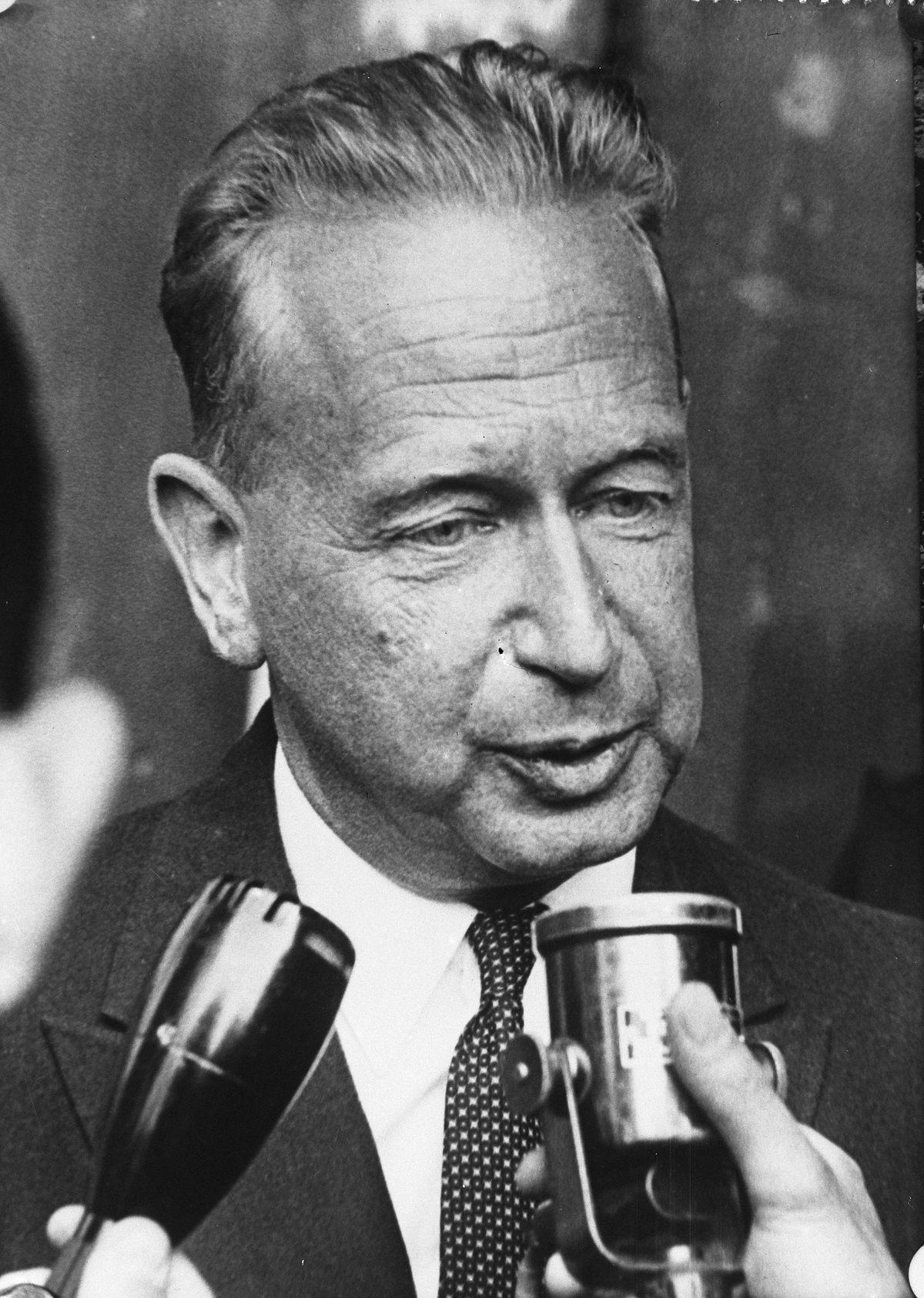
HAMMARSKJÖLD, Dag Hjalmar Agne Carl
Swedish civil servant and second Secretary-General of the United Nations (UN) 1953-1961
By Bob Reinalda · Version 14 October 2025
Was born 29 July 1905 in Jönköping, Sweden and died 18 September 1961 near Ndola, Northern Rhodesia (now Zambia). He was the son of Knut Hjalmar Leonard Hammarskjöld, lawyer and politician, and Agnes Almqvist.
Biography
Hammarskjöld, the youngest of four brothers, lived with his parents in Vasa castle in Uppsala until he was twenty-five. His father, who came from a family committed to public service without political affiliation, held several government positions (county governor, Prime Minister 1914-1917) and was an arbitrator in the Permanent Court of Arbitration. Hammarskjöld’s oldest brother Åke, Swedish diplomat seconded to the League of Nations, became the Permanent Court of International Justice’s Registrar in 1922. Hammarskjöld had a warm relationship with his mother. Her social assignments concerned children, poverty relief, the local community and handicrafts, culture and religion. She dealt intensively with theology and shared religious feelings with her son. After secondary school Hammarskjöld entered Uppsala University, where he, a lover of literature, first studied French literature and history (Bachelor of Arts, 1925), then three years of economics (including half a year in Cambridge in 1927, attending John Maynard Keynes’ lectures) and another two years of law (Bachelor of Laws, 1930). He moved to Stockholm, entering both government service as assistant secretary of a commission studying unemployment (1930-1934) and Stockholm University for his doctorate in political economy. The Stockholm School of Economics anticipated Keynesian politics and allowed him to use data from the commission’s study. In 1933 Hammarskjöld defended his dissertation on the spread of the business cycle, being publicly questioned by the economist Gunnar Myrdal, and became assistant professor (for three years).
In 1934 Hammarskjöld also became Second Under-Secretary at the Ministry of Finance, working toward a new approach to economic planning. Yet, in early 1935 Ivar Rooth, Governor of Sweden’s Central Bank (Riksbank), hired Hammarskjöld because he needed another economist on his staff. Rooth sent Hammarskjöld to the Bank for International Settlements in Basel, Switzerland and had him study the variety of central banks, also offering him a permanent position. However, in early 1936 Hammarskjöld became Under-Secretary in the Ministry of Finance, a position he kept until 1945. Soon he was successful in the required national budget reform by contributing key organizing concepts and winning ‘people over personally’ during the reform process (Lipsey 2013: 47). In 1941 the government made him Chairman of the Central Bank’s Board of Governors, thus becoming the first Swede to combine the two positions. He held the Chairman position until 1948, where he advocated for a planned economy. On a commercial mission to England in 1943 he learned that the Allied states distrusted Sweden’s position of neutrality, due to its trade with Nazi Germany. He followed the plans discussed at Bretton Woods closely (though Sweden had no observers there) but recommended that Sweden should wait and see to keep its freedom of manoeuvre. When Hammarskjöld discussed Sweden’s financial and trade problems with the Americans in 1947, he declared that Sweden’s absence ‘should not be given a principal meaning’ (Ahlström and Carlson 2006: 18).
As Sweden tried to remain neutral in the rising East-West tensions, it took time to join the United Nations (UN) (November 1946), the General Agreement on Tariffs and Trade (April 1950) and, in August 1951, the International Bank for Reconstruction and Development and the International Monetary Fund (with Rooth as the organization’s new Managing Director). From 1946 Hammarskjöld was also Envoy Extraordinary and Financial Advisor to the Ministry of Foreign Affairs, attending the 1947 Paris conference which launched the Marshall Plan and the meetings of the 1948 Organization for European Economic Cooperation, serving as vice-chairman of its Executive Committee (1948-1949). He also was a delegate to the Council of Europe (1949) and the UN General Assembly (in 1949; in 1951 as vice-chairman of the Swedish delegation; in 1952 as chairman). His focus shifted from the economy to foreign affairs when he took on positions as Under-Secretary in the Ministry of Foreign Affairs (1949-1951) and Minister without portfolio (1951-1953). In 1952 he diplomatically handled the Catalina incident, where two Swedish planes were shot down by the Soviet Union in international airspace over the Baltic Sea.
Due to an ongoing East-West rejection of candidates for the office of UN Secretary-General, following Trygve Lie’s resignation in November 1952, no acceptable successor was found. Yet, ten out of twelve Security Council members (none against, one abstention) selected the hardly known Hammarskjöld from a shortlist of four names on 31 March 1953. The choice surprised everyone, including Hammarskjöld, who the great powers considered a non-political bureaucratic civil servant. Even Lie, who had carved out a space for an active UN Secretary-General, feared that Hammarskjöld would be no more than a clerk. On 7 April the General Assembly approved Hammarskjöld with 57 of 59 votes. Catapulted into this position, Hammarskjöld started to restore the Secretariat (some 4,000 staff) by elaborating the position of the UN Secretary-General and the standing of the international civil service, using both his administrative experience and ethical ideas. His thoughts on action were based in the Swedish tradition of an impartial civil service and strongly influenced by an ethical perspective, as expressed in his spiritual diary Markings (1964, published after his death). His ethics were rooted in his interpretation of medieval mystics with ideas about service and solidarity of mankind, which he discussed with philosophers Martin Buber and Albert Schweitzer. He expressed his vision on UN action at press conferences, which he introduced as a regular form of exchange with representatives of the media, and in statements and speeches, both inside and outside the UN. He believed that leadership by the Secretary-General was the intention of the UN’s founders, as expressed in Charter principles in several articles, and defended his independence vis-à-vis other UN organs (Security Council, General Assembly, Trusteeship Council). Hammarskjöld frequently referred to the Charter and considered the UN a moral force. His reorganization improved the Secretariat’s set-up and efficiency. He made the Executive Office, headed by American Andrew Cordier, the centre for all work on political matters. Cordier made Hammarskjöld, fluent in multiple languages, personally greet all staff in New York (3,500), which increased their motivation. Hammarskjöld needed few hours of sleep and found time for his literary and artistic interests. He engaged museums and artists to contribute art to the UN headquarters and instituted the tradition of annual concerts on UN Day (24 October). Swedish Per Lind became his daily personal assistant and American Ralph Bunche, experienced in armistice agreements and awarded the 1950 Nobel Peace Prize, his assistant and troubleshooter in political work and peacekeeping.
When the People’s Republic of China (not a UN member, unlike the Republic of China or Taiwan) announced in November 1954 that it held detained United States (US) airmen who had served in the UN Command in Korea, US President Dwight Eisenhower called on the UN. Hammarskjöld felt he had to visit Peking himself and made sure that the General Assembly resolution included language that gave him considerable personal latitude as Secretary-General. Resolution 906(IX) of 10 December 1954 authorized him to undertake the mission ‘by the means most appropriate in his judgement’. He exchanged cables with Prime Minister Zhou Enlai, who received him in Peking in his individual capacity as Secretary-General, working toward the relaxation of international tensions and matters of concern to the Chinese. Even if it took months before all airmen were released, providing his good offices in this way became known as the ‘Peking Formula’ and the great powers realized that Hammarskjöld was someone to reckon with. 1955 was the year of the UN’s tenth anniversary, sixteen new member states and the conference on the peaceful uses of atomic energy.
In early 1956 Hammarskjöld made long trips to the Middle East and the Asia-Pacific to strengthen relations between the UN and its member states. Egypt’s nationalization of the Suez Canal Company in July, related to a US refusal to finance the construction of a dam on the Nile, resulted in a secretly prepared military response by France, Israel and the United Kingdom in late October (while the Soviet Union intervened militarily in Hungary to suppress a popular uprising). With the Security Council paralyzed, the Suez issue was transferred to an emergency session of the General Assembly, which called on the Secretary-General to act as appropriate. Initially sceptical about Canadian Prime Minister Lester Pearson’s proposal of a UN Emergency Force (UNEF) to move in and police a ceasefire, Hammarskjöld changed his mind. Bunche and Urquhart, the only Secretariat member with first-hand military experience, helped organize the group of military personnel, headed by E.L.M. Burns of the UN Truce Supervision Organization (founded to observe and maintain the 1948 Middle East ceasefire). Hammarskjöld proved central in all intense diplomatic discussions and in commanding UNEF. He convinced Egypt that its support of General Assembly Resolution 998(ES-1) to create UNEF implied acceptance of its presence on Egypt’s territory. In mid-November 1956 he flew with the first UNEF troops to Egypt and later explained the mission to all soldiers (some 3,500). They were not there to fight but to serve peace and order under UN authority. Since no UN helmets were available, US army helmets were painted blue. The UN also organized the canal clearance process. The Suez operation entrenched Hammarskjöld’s freedom of action (‘Leave it to Dag’), based on his moral authority in the sense of ‘devotion’ to UN principles (Fröhlich 2008: 161). UNEF (terminated by Egypt in 1967) proved the first of many UN peacekeeping operations, based on consent of the parties, impartiality and use of force limited to self-defence.
On 26 September 1957 Hammarskjöld was unanimously re-appointed as UN Secretary-General. Believing that unanimity was politically required for his second term, he felt more independent in his position as Secretary-General. In the 1958 conflict in the Middle East between Lebanon and its neighbours, he refused an armed peacekeeping force and instead created a UN observation group in Lebanon, which helped to defuse the conflict. He enriched the diplomatic vocabulary with the term ‘UN presence’, having Pier Spinelli, head of the UN Geneva Office, act as the first of many ‘personal and special representatives of the Secretary-General’ (Lipsey 2013: 358). In the winter of 1958-1959 Hammarskjöld visited major countries in South Asia as well as Moscow, where he met with Nikita Khrushchev, given ongoing East-West tensions and distrust between the Soviet Union and the US over nuclear testing and military flights over the Arctic. Hammarskjöld had little influence on issues on the agenda such as Laos, the Palestinian refugees and the expulsion of the Dalai Lama from Tibet.
In early 1960 Hammarskjöld visited 24 African countries and noticed that the number of capable leaders was limited. Later that year twelve new African states were admitted to UN membership. Soviet-US relations deteriorated after a US spy plane was shot down over Soviet territory in May. Civil strife was threatened in newly independent Congo, with the Soviet Union supporting one side and the US the other. The return of Belgian troops shortly after independence made the Congolese government appeal for UN assistance. Security Council Resolution 143(S/4387) of 14 July 1960 called upon Belgium to withdraw its troops and authorized the Secretary-General to provide the Congolese government with such military assistance as may be necessary until national security forces could take over. This resulted in a peacekeeping force with substantial military capacity (already 3,500 troops on 20 July). In September Khrushchev came to the UN General Assembly to berate the West. He accused Hammarskjöld of being pro-Western and demanded his resignation. He proposed to replace the Secretary-General by three secretaries (soon called ‘troika’): one from the West, one from the East and one from a neutral state. The General Assembly, however, rejected his proposal and Hammarskjöld refused to resign. The Congolese situation worsened because of the secession of Katanga by Moïse Tshombe, Prime Minister Patrick Lumumba’s accusation that the UN sided with Tshombe, and Lumumba’s assassination in January 1961. Hammarskjöld asked the Security Council to strengthen his mandate. In March the Soviet Union blamed Hammarskjöld for Lumumba’s death and again submitted its troika proposal, but once more without success as the US and the Asian and African members continued to back the Secretary-General. In May Hammarskjöld explained his vision about the restrictions of a Secretary-General in difficult situations in his lecture about the role of the international civil servant in law and in fact at Oxford University. On 18 September he and his staff, in route to negotiate a ceasefire in Congo, were killed in a plane crash in Northern Rhodesia.
This extremely tragic incident also presented the problem of choosing a successor as Secretary-General. The US wanted someone appointed quickly, but the Soviet Union created an impasse by again presenting its troika proposal. On 2 November the Security Council found the solution when Burmese diplomat U Thant agreed to complete Hammarskjöld’s term in office as Acting Secretary-General. The General Assembly approved the next day. The library at New York headquarters was named after Hammarskjöld and he was awarded the Nobel Peace Prize posthumously, having been nominated before his death, for ‘developing the UN into an effective and constructive international organization, capable of giving life to the principles and aims expressed in the UN Charter’ (Nobel Peace Prize 1961).
The first Rhodesian investigations into what happened before and during the crash of Hammarskjöld’s plane explained it as an accident. The 1962 UN’s inquiry, however, did not exclude sabotage or attack in the air. A 1992 Swedish report accused the Rhodesian officials on the ground of having deliberately delayed the search and rescue operations but dismissed allegations that the plane was shot down when approaching Ndola. Susan Williams, who raised the question of Who Killed Hammarskjöld? (2011), revealed more information suggesting that the crash probably was not simply an accident. She also noted the unavailability of information and disappearance of documents. Subsequent investigations supported the interference theory, rather than the accident one. The October 2024 report by former Tanzanian Chief Justice Mohamed Othman, in 2018 appointed as Eminent Person in the UN Hammarskjöld investigation, provided significant information in areas such as probable intercepts by member states of relevant information, the capacity of Katanga, or others, to have conducted a possible attack on Hammarskjöld’s plane and the presence of foreign paramilitary and intelligence personnel in the Ndola area. Othman is ‘almost certain that specific, crucial and to date undisclosed information exists in the archives of Member States’ of the UN (https://press.un.org/en/2024/sgsm22413.doc.htm).
Archives
- Dag Hammarskjöld Collection, Fonds L179, at National Library of Sweden, Stockholm, see https://arken.kb.se/SE-S-HS-L179
- The Dag Hammarskjöld Foundation (Uppsala, Sweden) publishes about both the UN and Hammarskjöld
- ‘Dag Hammarskjöld’ in the United Nations Oral History Collection, see www.un.org/depts/dhl/dag/oralhist.htm
- ‘Death of Dag Hammarskjöld’, see https://archives.un.org/content/death-dag-hammarskjold
Publications
- ‘From Bretton Woods to Full Employment’ in Svenska Handelsbanken’s Index, December 1945, Supplement A, 1-24
- ‘Sweden’s International Credit Accommodation in 1944 and 1945’ in Svenska Handelsbanken’s Index, December 1945, Supplement B, 1-24
- ‘A New Look at Everest’ in National Geographic, 119/1, January 1961, 87-93
- The International Civil Servant in Law and in Fact: Lecture Delivered to Congregation at Oxford University, 30 May 1961, New York 1961
- Castle Hill, Uppsala 1962
- Markings, New York 1964 (published in Swedish in 1963 as Vägmärken, several translations)
- A.W. Cordier and W. Foote (Eds), Public Papers of the Secretary-General of the United Nations, Volumes 2-5, New York 1972-1975
Literature
- ‘Hammarskjöld, Dag (Hjalmar Agne Carl)’ in: A. Rothe (Ed.), Current Biography: Who’s News and Why, New York 1953, 241-243
- J.P. Lash, ‘The U.N.’s Hammarskjold’ in The Progressive, January 1957, 17-20
- J.P. Lash, ‘The Man on the 38th Floor’ in Harper’s Magazine, October 1959, 47-52
- ‘The Nobel Peace Prize 1961: Dag Hammarskjöld’, see www.nobelprize.org/prizes/peace/1961/hammarskjold/biographical/
- M. Ascoli, ‘Dag Hammarskjöld’ in The Reporter, 12 October 1961, 12
- W.H. Auden, ‘Dag Hammarskjöld’ in Encounter, 17/5, November 1961, 3-4
- B. Hershey, Dag Hammarskjöld: Soldier of Peace, Chicago 1961
- J.P. Lash, Dag Hammarskjöld: Custodian of the Brushfire Peace, Garden City 1961
- R.L. Miller, Dag Hammarskjöld and Crisis Diplomacy, New York 1961
- I.E. Levine, Dag Hammarskjöld: Champion of World Peace, London 1962
- W. Lippmann, ‘Dag Hammarskjöld, United Nations Pioneer’ in International Organization, 15/4, 1961, 547-548
- L. Ross, ‘Dag Hammarskjöld’ in The New Yorker, 30 September 1961, 35
- W. Foote (Ed.), The Servant of Peace: A Selection of the Speeches and Statements of Dag Hammarskjöld, London 1962
- A.L. Gavshon, The Mysterious Death of Dag Hammarskjöld, New York 1962
- J.P. Lash, ‘Dag Hammarskjöld’s Conception of his Office’ in International Organization, 16/3, Summer 1962, 542-566
- O. Schachter, ‘Dag Hammarskjöld and the Relation of Law to Politics’ in The American Journal of International Law, 56/1, January 1962, 1-8
- S. Söderberg, Hammarskjöld: A Pictorial Biography, London 1962
- E. Stein, ‘Mr. Hammarskjöld, the Charter Law and the Future Role of the United Nations Secretary-General’ in American Journal of International Law, 56, 1962, 9-32
- O. Clausen, ‘Clues to the Hammarskjöld Riddle’ in The New York Times, 28 June 1964
- E. Gross, Dag Hammarskjöld as Secretary-General, New York 1964
- H.P. van Dusen, Dag Hammarskjöld: The Statesman and His Faith, New York 1964
- H. Morgenthau, ‘The U.N. of Dag Hammarskjöld is Dead’ in The New York Times, 14 March 1965
- E. Kelen, Hammarskjöld, New York 1966
- T.S. Settel (Ed.), The Light and the Rock: The Vision of Dag Hammarskjöld, New York 1966
- S. Stolpe, Dag Hammarskjöld: A Spiritual Portrait, New York 1966
- H.P. van Dusen, Hammarskjöld: A Biographical Interpretation of Markings, London 1967
- C.M. Simon, Dag Hammarskjöld, New York 1967
- E. Kelen (Ed.), Hammarskjöld: The Political Man, New York 1968
- G. Aulén, Dag Hammarskjöld’s White Book: An Analysis of Markings, Philadelphia 1969
- B. Beskow, Dag Hammarskjöld: Strictly Personal – A Portrait, New York 1969
- J.L. Henderson, Hammarskjöld: Servant of a World Unborn, London 1969
- E. Kelen, Dag Hammarskjöld: A Biography, New York 1969
- D. Thorpe. Hammarskjöld – Man of Peace, Ilfracombe 1969
- N. Gillett, Dag Hammarskjöld, London 1970
- M.W. Zacher, Dag Hammarskjöld’s United Nations, New York 1970
- R. Lichello, Dag Hammarskjöld: A Giant in Diplomacy, Charlotteville 1971
- B. Urquhart, Hammarskjöld, New York 1972
- M.G.K. Nayar, ‘Dag Hammarskjöld and U Thant: The Evolution of Their Office’ in Case Western Reserve Journal of International Law, 36, 1974, 36-83
- J.G. Sobosan, ‘Politics and Spirituality: A Study of Dag Hammarskjold’ in Cithara, 14, 1974, 3-12
- E.R. Montgomery, Dag Hammarskjöld: Peacemaker for the UN, Champaign 1975
- R. Dayal, Mission for Hammarskjöld: The Congo Crisis, London 1976
- G. Möllerstedt, General Sekretaren, film Sweden 1980
- G. Smith, ‘Hammarskjöld Was Killed by Mercenaries ‘ in Daily Nation (Nairobi), 22 May 1980, 17
- L.S. Trachtenberg, ‘Dag Hammarskjöld as Leader: A Problem of Definition’ in International Journal, 37/4, Autumn 1982, 613-635
- R.S. Jordan (Ed.), Dag Hammarskjöld Revisited: The UN Secretary-General as a Force in World Politics, Durham 1983
- B. Urquhart, ‘Hammarskjöld, Dag Hjalmar Agne Carl’ in: W.F. Kühl (Ed.), Biographical Dictionary of Internationalists, Westport 1983, 318-319
- P. Wallensteen, ‘Routes to Peace – The Thoughts of Dag Hammarskjöld and the Models of Peace Research’ in Current Research on Peace and Violence, 8, 1985, 161-164
- K.R. Gray, ‘United Nations Notebook: The Relationship of Dag Hammarskjöld with the Press’ in Development Dialogue, 1, 1987, 33-58
- B. Urquhart, ‘International Leadership: The Legacy of Dag Hammarskjöld’ in Development Dialogue, 1/1, 1987, 6-16
- G. Smith and C.C. O’Brien, ‘Hammarskjold Plane Crash “No Accident”’ in The Guardian, 9 November 1992, 18
- M.B. Oren, ‘Ambivalent Adversaries: David Ben-Gurion and Israel vs. the United Nations and Dag Hammarskjöld, 1956-57’ in Journal of Contemporary History, 27, 1992, 89-127
- D.N. Gibbs, ‘Dag Hammarskjöld, the United Nations, and the Congo Crisis 1960-1: A Reinterpretation’ in Journal of Modern African Studies, 31/1, 1993, 163-174
- B. Rösiö, ‘The Ndola Crash and the Death of Dag Hammarskjöld’ in Journal of Modern African Studies, 31, 1993, 661-671
- S. Meisler, ‘Dateline U.N.: A New Hammarskjöld’ in Foreign Policy, 98/1, 1995, 189-197
- P. Wallensteen, Dag Hammarskjöld, Stockholm 1995
- C.F. Hovde, ‘The Dag Hammarskjöld-John Steinbeck Correspondence’ in Development Dialogue, 1997/1-2, 97-129
- R. Lipsey, ‘Blessed Uneasiness: Dag Hammarskjöld on Conscience’ in Parabola, 22/3, August 1997, 47-57
- B. Thelin, Fostered to Internationalism and Peace: Biographical Notes on UN Secretary-General Dag Hammarskjöld, Malmö 1998
- M. Fröhlich, ‘A Fully Integrated Vision: Politics and the Arts in the Dag Hammarskjöld-Barbara Hepworth Correspondence’ in Development Dialogue, 2001/1, 17-57
- P.B. Heller, The United Nations under Dag Hammarskjöld, 1953-1961, New York 2001
- Memories of Dag Hammarskjöld: On the 40th Anniversary of his Death, New York 2001 (Association of Former International Civil Servants)
- M.-N. Little (Ed.), The Poet and the Diplomat: The Correspondence of Dag Hammarskjöld and Alexis Leger, Syracuse 2001
- M. Fröhlich, Dag Hammarskjöld und die Vereinten Nationen: Die politische Ethik des UNO-Generalsekretärs, Paderborn 2002
- B. Thelin, Dag Hammarskjöld, Stockholm 2002
- S. Mögle-Stadel, Dag Hammarskjöld: Visionary for the Future of Humanity, Capetown 2002
- J. King and A.J. Hobbins, ‘Hammarskjöld and Human Rights, the Deflation of the UN Human Rights Programme 1953-1961’ in Journal of the History of International Law, 5, 337-386
- Dag Hammarskjöld 100th Anniversary, Special Issue Sveriges Riksbank Economic Review, 2005/3
- S. Ask and A. Mark-Jungkvist (Eds), The Adventure of Peace: Dag Hammarskjöld and the Future of the UN, New York 2005
- M. Bouman, Dag Hammarskjöld: Citizen of the World, Kampen 2005
- K. Falkman (Ed.), To Speak for the World: Speeches and Statements by Dag Hammarskjöld, Stockholm 2005
- S. Holmquist, Visions of a Secretary-General: Dag Hammarskjöld and the United Nations 1953-1961, Athena film Sweden 2005
- M.E. Vargo, Noble Lives: Biographical Portraits of Three Remarkable Gay Men – Glenway Wescott, Aaron Copland, and Dag Hammarskjöld, Binghamton 2005
- P. Wallensteen and O. Nordberg (Eds), Report of the Dag Hammarskjöld Symposium on Respecting International Law and International Institutions, Uppsala 2005
- G. Ahlström and B. Carlson, Sweden and Bretton Woods, 1943-1951, Lund 2006
- K. Falkman, A String Untouched: Dag Hammarskjöld’s Life in Haiku and Photographs, Winchester 2006
- K. Kille, From Manager to Visionary: The Secretary-General of the United Nations, New York 2006
- A.J. Lyon, ‘Moral Motives and Policy Actions: The Case of Dag Hammarskjöld at the United Nations’ in Public Integrity, 9/1, Winter 2006-7, 79-95
- A.J. Lyon, ‘The UN Charter, the New Testament, and Psalms: The Moral Authority of Dag Hammarskjöld’ in K. Kille (Ed.), The UN Secretary-General and Moral Authority: Ethics and Religion in International Leadership, Washington DC 2007, 111-141
- C. Grundsten, Swedish Wilderness: The Mountain World of Dag Hammarskjöld, Stockholm 2007
- P.R. Nelson, Courage of Faith: Dag Hammarskjöld’s Way in Quest of Negotiated Peace, Reconciliation and Meaning, Frankfurt am Main 2007
- Critical Currents: Beyond Diplomacy: Perspectives on Dag Hammarskjöld, Uppsala 2008
- M. Fröhlich, Political Ethics and the United Nations: Dag Hammarskjöld as Secretary-General, London 2008
- M. Fröhlich, ‘The Unknown Assignation: Dag Hammarskjöld in the Papers of George Ivan Smith’ in Critical Currents, Nr. 2, March 2008, 9-35
- S. Linner and S. Aström, UN Secretary-General Hammarskjöld: Reflections and Personal Experiences, Uppsala 2008
- Critical Currents: Can We Save True Dialogue in an Age of Mistrust? The Encounter of Dag Hammarskjöld and Martin Buber, Uppsala 2010
- R. Lipsey, ‘Desiring Peace: A Meditation on Why Dag Hammarskjöld Matters’ in Parabola, 35/3, Fall 2010, 20-29
- M.-N. Little, The Knight and the Troubadour: Dag Hammarskjöld and Ezra Pound, Uppsala 2010
- H. Melber (Ed.) The Ethics of Dag Hammarskjöld, Uppsala 2010
- J. Troy, ‘Dag Hammarskjöld: An International Civil Servant Uniting Mystics and Realistic Diplomatic Engagement’ in Diplomacy and Statecraft, 21/3, 2010, 434-450
- M.-L. Henley and H. Melber (Eds), Dag Hammarskjöld Remembered: A Collection of Personal Memories, Uppsala 2011
- R. Lipsey, ‘Dag Hammarskjöld and Markings: A Reconsideration’ in Spiritus, 11/3, Spring 2011, 84-103
- H. Melber (Ed.), Dag Hammarskjöld and Global Governance, Uppsala 2011
- H. Melber and M. Schoeman (Eds), ‘The United Nations and Regional Challenges in Africa – 50 Years After Dag Hammarskjöld’ in Development Dialogue, No. 57, December 2011
- T. Sellström, ‘Hammarskjöld and Apartheid South Africa: Mission Unaccomplished’ in African Journal on Conflict Resolution, 11/1, 2011, 35-62
- G. Torén (Ed.), Dag Hammarskjöld on the 50th Anniversary of his Death: A Compilation Based on the Collections of the Dag Hammarskjöld Library, Uppsala, Uppsala 2011
- S. Williams, Who Killed Hammarskjöld? The UN, the Cold War and White Supremacy in Africa, London 2011
- Dag Hammarskjöld: Instrument, Catalyst, Inspirer, New York 2012
- R.1, ‘Freedom in the Midst of Action: United Nations Leader Dag Hammarskjöld and Buddhism’ in Tricycle, Fall 2012, 80-83
- H. Melber, ‘Dag Hammarskjöld, the United Nations and Africa’ in Review of African Political Economy, 39/131, 2012, 151-159
- G. Björkdahl and J. Phiri, ‘The Hammarskjöld Plane Crash’ in International Peacekeeping, 20/1, 2013, 98-115
- R. Lipsey, Hammarskjöld: A Life, Ann Arbor 2013
- H. Melber, ‘The Death of Dag Hammarskjöld’ in Review of African Political Economy, 41/141, 2014, 458-465
- H. Melber, ‘Faith as Politics – and Politics as Faith: Beyers Naudé and Dag Hammarskjöld’ in Journal for Contemporary History, 40/2, 2015, 96-109
- F. Dionigi, ‘Dag Hammarskjöld’s Religiosity and Norms Entrepreneurship: A Postsecular Perspective’ in Politics and Religion, 9/1, 2016, 162-186
- C. Stahn and H. Melber (Eds), Peace Diplomacy, Global Justice and International Agency: Rethinking Human Security and Ethics in the Spirit of Dag Hammarskjöld, Cambridge 2014
- H. Berggren, Dag Hammarskjöld: Markings of His Life, Stockholm 2016
- H. Melber, ‘Mission Impossible: Hammarskjöld and the UN Mandate for the Congo (1960-1961)’ in African Security, 10/3-4, 2017, 254-271
- A. O’Malley, Diplomacy of Decolonization: America, Britain and the United Nations during the Congo Crisis 1960-1964, Manchester 2018
- M. Brügger and G. Björkdahl, Cold Case Hammarskjöld, documentary Sweden 2019
- H. Melber, Dag Hammarskjöld, the United Nations and the Decolonization of Africa, London 2019
- M. Picard, Ils ont tué Monsieur H.: Congo 1961, Paris 2019
- E.-M. Muschik, Building States: The United Nations, Development, and Decolonization, 1945-1965, New York 2021
- R. Somaiya, Operation Morthor: The Death of Dag Hammarskjöld and the Last Great Mystery of the Cold War, London 2021
- P. Fly, Hammarskjöld, film Sweden 2023
(all websites accessed 15 August 2025)
How to cite
Bob Reinalda, 'Hammarskjöld, Dag Hjalmar Agne Carl' in IO BIO, Biographical Dictionary of Secretaries-General of International Organizations , edited by Bob Reinalda, Kent J. Kille and Jaci L. Eisenberg. https://sandbox.zenodo.org/records/506830 (sandbox preview)
Text © the author(s) and IO BIO, licensed under CC BY-NC-ND 4.0. The portrait is excluded and remains under the rights of its credited source. We have tried to trace the rights holder to obtain permission for the use of the portrait, but contact us in case we have failed.