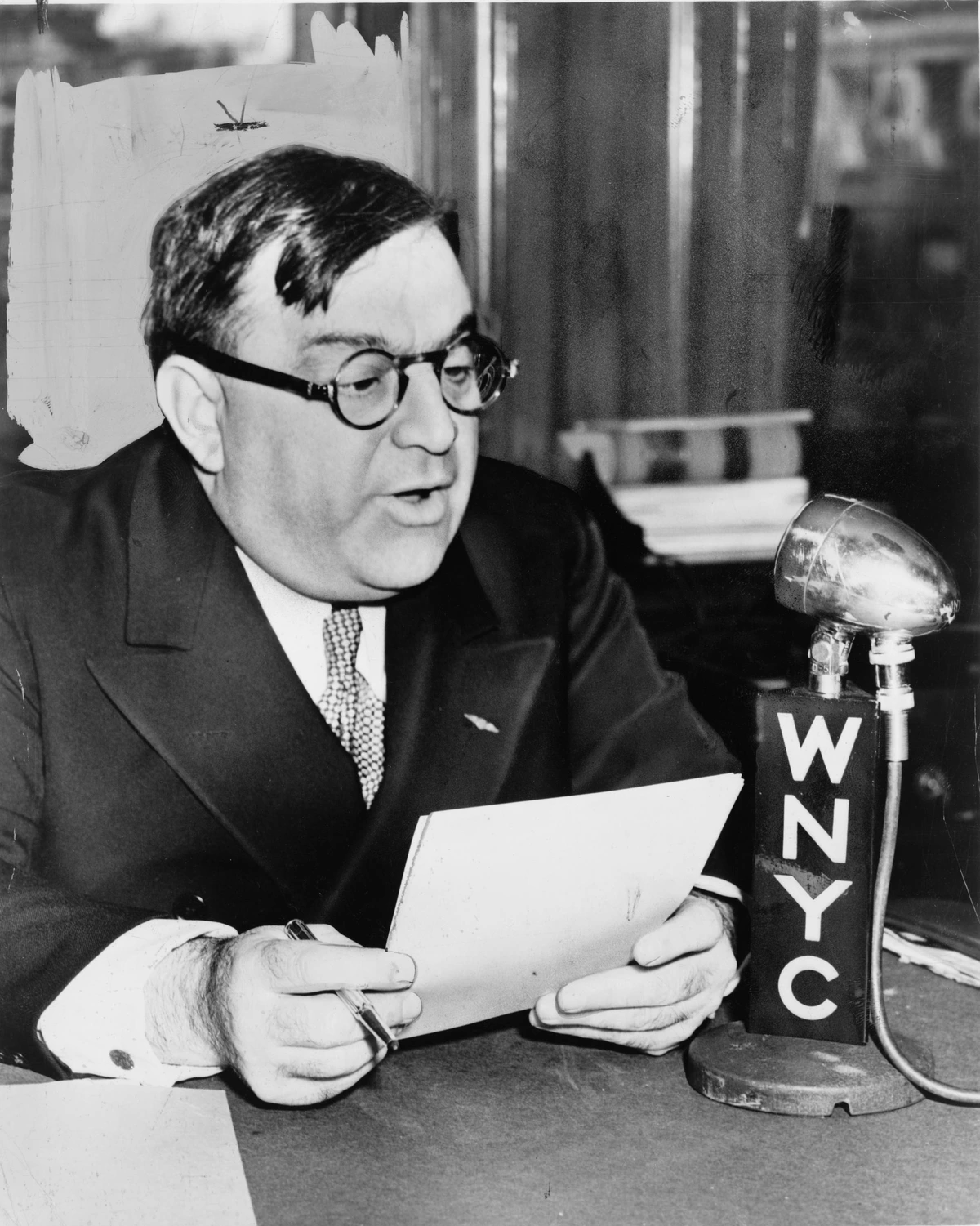
LA GUARDIA, Fiorello Raffaele Enrico (‘Raffaele’ was removed later and ‘Enrico’ Americanized to ‘Henry’)
American politician and second Director-General of the United Nations Relief and Rehabilitation Administration (UNRRA) 1946
By Chloé Maurel · Version 29 September 2026
Was removed later and ‘Enrico’ Americanized to ‘Henry’), American politician and second Director-General of the United Nations Relief and Rehabilitation Administration (UNRRA) 1946, was born 11 December 1882 in New York City and died 20 September 1947 in New York City. He was the son of Achille Luigi Carlo La Guardia, musician and army bandmaster, and Irene Luzatto-Coen. On 8 March 1919 he married Thea Almerigotti (who died in November 1921), with whom he had a daughter (who died in May 1921). On 28 February 1929 he married Marie Fischer, secretary and office manager, with whom he adopted a girl and a boy.
Although his surname was almost always written as two words, La Guardia signed his surname as a single word.
Biography
La Guardia was born into a family of immigrants. His father was an Italian-born musician who served in the United States (US) Army, while his mother came from a Jewish family originating in Trieste, then part of the Austro-Hungarian Empire. His parents moved to the US in 1880 and did not allow the children to speak Italian as they wanted to adapt to the new country. Owing to his father’s military assignments, La Guardia spent part of his childhood and schooling in the American Southwest. In 1898 he did not join the army during the Spanish-American War (because of his age) but became a war correspondent for the St. Louis Post-Dispatch. In 1900 the family moved to Trieste, where La Guardia learned to speak Italian. In 1901 he served as clerk in the American Consular Service in Budapest, Hungary and, given his knowledge of Italian, he moved to the Consular Service in Fiume, an autonomous district of Austria-Hungary where the population predominantly spoke Italian. From 1903 he oversaw the Consular Service there and was promoted to Consular Agent in 1904. When he did not become Consul-General in 1906 he resigned and returned to the US. His American and European experiences at an early age exposed him to different cultures and languages. By adulthood he was fluent in several languages, including Croatian, English, German, Italian and Yiddish. In New York he worked as an interpreter for the US Immigration Service at Ellis Island. This experience acquainted him directly with the lives of immigrants arriving in the US and reinforced his lifelong sympathy for disadvantaged populations. He had several jobs, took a speedwriting course and registered for night classes at New York University Law School, receiving his Bachelor of Laws in 1910.
La Guardia was admitted to the bar in 1910 and worked for the Attorney-General of New York starting in 1911, serving as Deputy Attorney-General from 1915 to early 1917. He soon became active in politics as a member of the Republican Party, although throughout his career he frequently cooperated with reformers, independents, socialists and progressive movements. La Guardia was elected to the US House of Representatives in 1916, after an unsuccessful effort in 1914. His Congressional career lasted from March 1917 to 31 December 1919, when he resigned, and from March 1923 until March 1933. It established him as one of the most independent and progressive voices in American politics. During the First World War La Guardia, who was interested in airplanes, absented himself from the House in August 1917 to serve in the US Army Air Service in Italy, where he trained pilots, participated in military operations and attained the rank of Major, a title by which he was often known thereafter. When he returned to New York in 1919, he engaged in municipal politics as President of New York’s Board of Aldermen (1920-1921). 1921 was a difficult year for him. He lost the Republican primary for Mayor of New York City and both his daughter and wife died due to tuberculosis, a disease related to poor living conditions. As a member of the House since 1923 La Guardia emerged as a vigorous advocate of social reform. He supported labour rights, unemployment insurance, old-age pensions, public housing, women’s rights and public investment. He opposed racial discrimination, criticized restrictive immigration legislation and fought political corruption. Together with Senator George Norris, he helped secure the passage of the Norris-La Guardia Act of 1932, which limited the use of anti-union injunctions in labour disputes. At a time when Conservative political forces remained influential, his positions made him one of the leading progressive Republicans in the US.
La Guardia’s greatest political achievements came as Mayor of New York City. While still in Congress in 1929, his mayoral campaign was unsuccessful, but he benefited from the political crisis created by corruption scandals surrounding Mayor James Walker and the devastating effects of the Great Depression. In 1932 La Guardia resigned from Congress after failing to win re-election. In 1933 he was elected Mayor at the head of a broad coalition bringing together Republicans, reformers, independents and anti-Tammany Democrats (opponents of the traditional and powerful political machine of the Democratic Party). When La Guardia entered office on 1 January 1934, New York City faced severe financial and social difficulties. Hundreds of thousands of residents were unemployed, municipal finances were strained and public confidence in city government had been badly damaged. La Guardia responded with a programme of administrative reform, public investment and modernization. He appointed experts rather than political loyalists, reorganized municipal departments and fought corruption with great determination. His second wife, whom he had married in 1929, became his efficient secretary and office manager. La Guardia’s administration coincided with President Franklin Roosevelt’s New Deal and La Guardia established a close working relationship with the federal government. Through his political skills and personal rapport with Roosevelt, he secured substantial federal funding for New York City.
Under La Guardia’s leadership, the city undertook major infrastructure projects, including bridges, tunnels, highways, airports, schools, hospitals, parks and public housing developments. Historians often regard La Guardia as one of the principal architects of modern New York City. Among his most important accomplishments was the expansion of municipal government as an instrument of social welfare and urban development. The city developed its first large-scale public housing programmes, modernized transportation systems and expanded public services. He also supported cultural initiatives, including public funding for the arts and music. New York emerged during his mayoralty as a model of urban reform and administrative efficiency. La Guardia profited from his international contacts as US Delegate to the Inter-Parliamentary Conferences in Berlin, Germany (1928) and London, United Kingdom (1930) regarding issues such as parliamentary control of foreign policy and the economic consequences of the global financial crisis. La Guardia’s popularity became immense and extended well beyond New York. From 1936 to 1945 he served as President of the US Conference of Mayors and became one of the principal spokespersons for urban America. Roosevelt himself frequently praised his effectiveness. According to a famous anecdote, the President joked that La Guardia could always obtain federal funds by arriving in Washington with a compelling story about the needs of New York City.
La Guardia was not an American isolationist, but supported an American foreign policy focused on democracy. This made him speak, at an earlier moment, in favour of the League of Nations, as well as the Inter-Parliamentary Union and international disarmament conferences. When the Second World War broke out, he became involved in national defence administration early on. In the Spring of 1941 Roosevelt appointed La Guardia as Director of the Office of Civilian Defense, an agency responsible for coordinating civilian preparedness in the event of attack. Although his tenure was relatively brief, it reflected the confidence that the federal government placed in his administrative abilities. Since La Guardia also ran for a third term as Mayor, he spent three days in Washington DC on civil defence, followed by the other days to run New York City. He believed he could do both jobs equally well but had to drop the civilian defence work in February 1942. Yet, in a certain way he was also tired of the mayoralty, as his original agenda had been accomplished: ‘He was a man who always needed some new challenge, and with the nation at war he wanted to be on the front’ (Kessner 2000: 5). La Guardia looked for a military position and talked to Dwight Eisenhower about a generalship in Italy or North Africa, but Roosevelt decided that this was not a good idea, much to La Guardia’s disappointment and he remained in office as Mayor until 1945. From 1940 he also chaired the US section of the Permanent Joint Board on Defense with Canada and in December 1944 he was part of the American delegation to the International Civil Aviation Conference in Chicago, where delegates from 44 Allied countries gathered to standardize air navigation rules.
The international dimension of La Guardia’s career emerged most clearly after the war. In early 1946 President Harry Truman appointed him as his Special Representative to Brazil with the rank of Ambassador. La Guardia attended the inauguration of the new Brazilian President to enhance post-war relations with the country, but he did not seek to become the new Ambassador. When Truman appointed Herbert Hoover as Chairman of the Famine Emergency Commission in early March, Hoover soon criticized the policies of Herbert Lehman, the Director-General of the United Nations Relief and Rehabilitation Administration (UNRRA), as he ‘favored rationing’, with which Hoover disagreed (McDonald 2015: 200). Hoover proposed naming one of his companions in Lehman’s place. Lehman subsequently resigned and Truman appointed La Guardia as the new Director-General of UNRRA on 1 April 1946. This appointment reflected both his administrative reputation and his longstanding commitment to public service. UNRRA was created by 44 Allied countries at a conference in the White House in Washington DC in November 1943 to confront the massive task of global reconstruction through relief supplies, refugee assistance and economic recovery during and after the war. UNRRA had its headquarters in Washington, and its administration included offices and missions with a staff totalling nearly 25,000. UNRRA was responsible for coordinating relief and reconstruction efforts by providing food, medical assistance, clothing, shelter and logistical support to millions of displaced persons and civilian victims across Europe and Asia. The effort represented a pioneering experiment in multilateral humanitarian cooperation and foreshadowed several specialized agencies of the United Nations (UN) that was created in October 1945.
In May and June 1946 La Guardia sat on the Committee on Finances (in a consultative capacity) of the UN’s Economic and Social Council, which prepared a draft budget for the first fiscal year of the new body. In July the Committee met in London where it also prepared the provisional administrative and operational budgets for the first financial year of the International Refugee Organization (IRO). The IRO was founded in April 1946 as a temporary UN agency to deal with the massive issue of refugees and displaced persons. The organization was also meant to assume most of the refugee functions of UNRRA (other functions to be dealt with by new UN specialized agencies were food and health, taken care of by the Food and Agriculture Organization and the Interim Commission that became the World Health Organization in 1948). Among the problems discussed in London were ‘the scales according to which contributions to these budgets might be allocated in an equitable way among the members of the UN’, having due regard to the exceptionally difficult financial situation of countries which had formerly suffered under enemy occupation (Holborn 1956: 39). La Guardia travelled extensively, advocated continued international assistance to populations affected by the war and sought to maintain public support for relief programmes despite growing donor fatigue. His speeches emphasized the dangers of poverty, hunger and social dislocation in post-war societies and argued that prosperity and security required international cooperation rather than isolation. The themes he developed during these years reflected the broader vision of collective responsibility that was shaping the post-war international order. The speech he delivered from New York’s municipal radio station in August 1944 on post-war reconstruction already revealed his concern for employment, social welfare, international economic cooperation and long-term planning in the transition from war to peace. He viewed reconstruction not merely as a humanitarian obligation but as a prerequisite for international peace and stability. After the war he rejected the emerging East-West divide and advocated peaceful coexistence with the Soviet Union. He therefore provided UNRRA funds to the Soviet Union, despite warnings that the money would be used for military purposes. In doing so, he opposed the idea of restricting international relief on political grounds and advocated continuing assistance to the Soviet Union and other war-affected countries. This position reflected his broader commitment to international cooperation at a time when relations between the US and the Soviet Union were deteriorating, which materialized with the Truman Doctrine in March 1947, followed by the Marshall Plan a few months later.
The arrest of La Guardia’s sister Gemma and her family members by the Nazis was a personal blow to the man who in his leadership to combat New York corruption had insisted on adherence to official rules. Gemma had married a Hungarian and moved to Budapest. When, in early 1944, German troops occupied Hungary 440,000 Jews were deported. Gemma was imprisoned in successively Auschwitz, Mauthausen and Ravensbrück, where the Nazis discovered that she was La Guardia’s sister and as such a potentially useful political prisoner. This helped her survive. After the war, in July 1945, Gemma managed to write to her brother and asked him to get her and her family members over to the US. UNRRA helped displaced persons return home, but her brother, who cared about her, was ‘law abiding to a fault’ (Calvin 2015: 3). He took three and a half months to answer through the American Red Cross, as he refused to use non-legal methods of communications. The situation proved more complicated as she had lost American citizenship by her marriage and had no rights to enter the US. Given the restrictive immigration legislation, La Guardia found it tricky to sponsor them. However, when Gemma found out that her husband had died, she regained her American citizenship, but this was not true for her daughter and grandson who had also survived. As UNRRA Director-General La Guardia also used the proper channels. Yet, he sent an affidavit to the State Department for the daughter and grandson to travel with his sister. They did not return to New York until May 1947, while UNRRA had created a Central Tracking Bureau to try to bring relatives together.
On 1 January 1947 Major-General Lowell Rooks succeeded La Guardia as Director-General of UNRRA. La Guardia’s health deteriorated rapidly during 1947. Suffering from pancreatic cancer, he nevertheless continued to speak out politically almost until the end of his life. In September 1947 he died in New York City at the age of sixty-four. His death prompted tributes from political leaders across the US and abroad. By that time he had become a symbol of honest government, urban reform and public service. La Guardia’s legacy rests on several distinct achievements. As Mayor during the Great Depression and the Second World War, he transformed New York City from a fragmented and often corrupt municipal system into a more modern and effective metropolis. As a progressive politician, he championed social reform, labour rights and government responsibility toward vulnerable populations. La Guardia’s role at UNRRA deserves particular attention because it is often overshadowed by his mayoral career. As Director-General of UNRRA near the end of his life he contributed to one of the earliest experiments in large-scale international humanitarian cooperation and helped bridge the transition from wartime relief efforts to the emerging system of international cooperation under the auspices of the UN, even if his tenure lasted only for nine months. For these reasons, he remains a remarkable American political figure of the twentieth century, also in the history of international organizations.
Archives
- ‘Fiorella H. La Guardia Papers 1918-1945’ in The New York Public Library, see https://archives.nypl.org/mss/1673
- ‘F.H. La Guardia’ in United Nations Archives and Records Management Section, New York, see https://search.archives.un.org/informationobject/browse?topLod=0&sort=relevance&query=La+Guardia+
Publications
- ‘Postwar Problems’ in Vital Speeches of the Day, 10/24, 1944, 750-755
- The Making of an Insurgent: An Autobiography, 1882-1919, Philadelphia 1948
Literature
- Obituary in The New York Times, 21 September 1947
- L.W. Holborn, The International Refugee Organization: A Specialized Agency of the United Nations: Its History and Work 1946-1952, London 1956
- A.H. Mann, La Guardia: A Fighter Against His Times, 1882-1933, Philadelphia 1959
- H. Zinn, La Guardia in Congress, Ithaca 1959
- A.H. Mann, La Guardia Comes to Power: The Mayoral Election of 1933, Philadelphia 1965
- A. Heckscher, When La Guardia Was Mayor: New York’s Legendary Years, New York 1978
- L. Elliott, Little Flower: The Life and Times of Fiorello La Guardia, New York 1983
- Th. Kessner, Fiorello H. La Guardia and the Making of Modern New York, New York 1989
- H. Kaufman, ‘Fiorello H. La Guardia, Political Maverick’ in Political Science Quarterly, 105/1, 1990, 113-122
- Th. Kessner, ‘La Guardia, Fiorello Henry (11 December 1882-20 September 1947)’ in American National Biography online, 2000
- ‘LaGuardia, Fiorello Henry’ in Who’s Who and Who Was Who, 1 December 2007
- Ph. Orchard, A Right to Flee: Refugees, States, and the Construction of International Cooperation, Cambridge 2014
- J.G. McDonald, To the Gates of Jerusalem: The Diaries and Papers of James G. McDonald 1945-1947, Bloomington 2015
- K. Calvin, ‘How Fiorello La Guardia Helped Refugees and His Own Sister’ at https://unfoundation.org/blog/post/how-fiorello-la-guardia-helped-refugees-and-his-own-sister/, 1 October 2015 (all websites approached on 20 July 2026). Chloé Maurel
How to cite
Chloé Maurel, 'la Guardia, Fiorello Raffaele Enrico' in IO BIO, Biographical Dictionary of Secretaries-General of International Organizations , edited by Bob Reinalda, Kent J. Kille, Jaci L. Eisenberg, Ellen Ravndal and Dawisson Belém Lopes. https://sandbox.zenodo.org/records/611856 (sandbox preview)
Text © the author(s) and IO BIO, licensed under CC BY-NC-ND 4.0. The portrait is excluded and remains under the rights of its credited source. We have tried to trace the rights holder to obtain permission for the use of the portrait, but contact us in case we have failed.