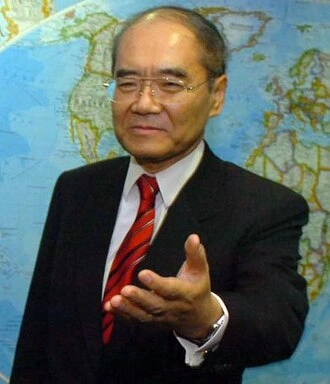
MATSUURA, Kōichirō
Japanese diplomat and ninth Director-General of the United Nations Educational, Scientific and Cultural Organization (UNESCO) 1999-2009
By Mariko Shoji · Version 28 June 2026
Was born 29 September 1937 in Ebara Ward, Tokyo, Japan. He is the son of Seiichi Matsuura, office employee, and Kiyoko Matsuya. On 24 March 1967 he married Takako Kirikae, with whom he had two sons.
Biography
Matsuura’s father worked as an employee of the Mitsui Life Insurance company, while his mother was a member of the well-known Matsuya sake brewing family. Matsuura’s early childhood was partially spent in Shimaji Village in the Yamaguchi Prefecture, his paternal hometown. Following his father’s job transfer, the family relocated to Tianjin, China. However, due to the escalation of the Second World War in 1939, the family returned to Japan. Matsuura completed his secondary education at Gakushuin Middle School in March 1953 and then graduated from Tokyo Metropolitan Hibiya High School in 1956. While enrolled at the University of Tokyo’s Faculty of Law he successfully passed the diplomatic service examination in 1958, leading to his entry into the Ministry of Foreign Affairs in 1959. Subsequently he pursued his studies at Haverford College in Pennsylvania, United States (US), where he earned a Bachelor of Arts degree in Economics in 1961. This collegiate experience, marked by engagement with diverse cultural backgrounds and belief systems, contributed to his cultivation of a broader worldview and sense of responsibility toward global issues. His favourite sports became tennis, golf and mountain climbing.
Upon his return to the Ministry of Foreign Affairs in 1961 Matsuura’s inaugural overseas assignment was to Ghana, where he served as third secretary of the embassy and was responsible for diplomatic relations with nine other West African countries: Côte d’Ivoire, Dahomey (later Benin), Guinea, Liberia, Mali, Niger, Sierra Leone, Togo and Upper Volta (later Burkina Faso). In 1967 he married Takako Kirikae, the eldest daughter of Jiro Kirikae (managing director at the Mitsubishi Corporation). In 1968 he became secretary of the Japanese Delegation to the Organization for Economic Co-operation and Development (OECD) in Paris, France, where he was responsible for general affairs for four years. During this period Japan acceded to the OECD’s Development Assistance Committee and initiated aid efforts toward Asian countries. This posting intensified Matsuura’s engagement with global concerns and augmented his interest in Official Development Assistance. Throughout the 1970s he accrued varied diplomatic experiences across regions, including his service as a counsellor in charge of economic affairs at the Embassy of Japan in the US (1977-1980). He played a role in navigating the path for Japan and the US to overcome trade tensions, thereby establishing the foundation for a more robust and enduring framework of economic collaboration.
He returned to Japan’s Ministry of Foreign Affairs to become Director of the Aid Policy Division (1980-1982), Director of the General Affairs Division and Deputy Director of the Foreign Minister’s Office (1982-1985). From 1985 to 1988 Matsuura was Japan’s Consul-General in Hong Kong. As part of his job, he delivered lectures to deepen the audiences’ comprehension of Japan’s political system, economic architecture and cultural heritage. His ascent within the headquarters of the Ministry of Foreign Affairs culminated in key appointments as Director-General of the Economic Cooperation Bureau (1988-1990) and Director-General of the North American Affairs Bureau (1990-1992). As Director-General of the Economic Cooperation Bureau Matsuura was integral to the formulation and implementation of Japan’s development assistance policy. Within the framework of the OECD’s Development Assistance Committee he underscored the imperative of delivering development assistance in an environmentally conscious and sustainable manner, advocating for active engagement with locally knowledgeable non-governmental organizations. He also recognized the significant function of Japan’s development assistance in elevating the country’s image among developing countries. As Director-General of the Bureau of North American Affairs, he undertook a critical role in diplomatic negotiations within the North American sphere. Following the eruption of the Gulf War in 1990 he provided clarification that Japan was constrained by its constitutional limitations. Yet he conveyed the country’s commitment to actively provide financial support. After the end of this conflict he sought international acknowledgment for Japan’s contribution through the deployment of self-defence forces for the minesweeping operations in the Persian Gulf.
From 1992 to 1994 Matsuura served as Deputy Minister for Foreign Affairs and concurrently functioned as Japan’s Sherpa (the personal representative of Japan’s Prime Minister) at the G7 Summits in Munich, Germany, Tokyo and Naples, Italy. He assumed the responsibility of coordinating high-level discussions on international economic and political matters. At the time the role of Russia was a significant point of contention. Despite Japan’s reservations, due to its Northern Territories issue with Russia, the broader international community deemed engagement with Russia indispensable for establishing a new global order. The eventual consensus allowed Russia’s partial participation, establishing the G7+1 (or G8) format. Furthermore, during the Japan-US comprehensive economic negotiations, where the US pressed Japan to institute numerical targets for government procurement, Matsuura maintained that such contracts must be adjudicated through fair competition, deeming the preferential treatment of US firms unjustifiable. From 1994 to 1999 Matsuura was commissioned as Japan’s Ambassador to France, diligently striving to foster friendly relations and deepen economic and cultural exchange between the two states. During this tenure he also held accreditation as Ambassador to the Principality of Andorra and the Republic of Djibouti. His efforts to foster mutual understanding were exemplified by the establishment of the Maison de la culture du Japon à Paris in 1997, extensive lectures across France and the publication of two books in French: one about the history of relations between Japan and France (1995) and another about the current state of Japanese diplomacy on the eve of the twenty-first century (1998).
Matsuura’s involvement with the activities of the United Nations Educational, Scientific and Cultural Organization (UNESCO) began with Japan’s ratification of the 1992 World Heritage Convention and developed during his assignment in France. From 1998 to 1999 he chaired UNESCO’s World Heritage Committee and presided over its annual session in Kyoto in 1998. UNESCO itself had struggled with management problems and politicization since the 1980s. In 1999 the succession of UNESCO Director-General Federico Mayor became a public struggle, unlike before when candidates came from within the organization’s own ranks. Japan pushed for Matsuura, who also received support from France, while Saudi Arabia promoted diplomat-poet Ghazi Algosaibi. The governments of Saudi Arabia and Japan lobbied heavily, and both candidates received strong funding, which was viewed by the press as chequebook diplomacy. On 12 November Matsuura was elected Director-General for six years in the third round of voting by 34 of the 58 countries on the Executive Board. Algosaibi received 13 votes. Following his selection Matsuura was regarded as the man who had to combat poor management and cronyism within the organization, a complex situation referred to as the crisis of UNESCO.
UNESCO’s organizational problems were longstanding. They started during the tenure of Director-General Amadou M’Bow (1974-1987) and continued under Mayor (1987-1999). The organization was confronted with multiple challenges, including the withdrawal of the US in 1984 and, in 1985, of Singapore and the United Kingdom (UK) (the UK rejoined in 1997). The departure of the US, a major financial contributor, posed a serious threat to UNESCO’s sustainability. One reason for these withdrawals was the perception that UNESCO under M’Bow had adopted a critical stance toward Western countries. The organization was seen as leaning toward the positions of the Non-Aligned Movement and the Soviet bloc states, resulting in resolutions viewed as anti-Western. UNESCO’s 1976 initiative, the New World Information and Communication Order, was aimed to correct global imbalances in media representation (an issue that was also on the agenda at UNESCO). In 1980 the initiative was formally accepted at UNESCO’s General Conference in Belgrade, Yugoslavia with the publication of the Seán MacBride report Many Voices, One World. The Soviet bloc accused the Western world of media hegemony and argued that international news was dominated by Western agencies in a manner that neglected the perspectives of the developing countries. The US interpreted this as a threat to press freedom as well as an anti-Western, anti-capitalist ideology which heightened Cold War tensions. The US also criticized M’Bow’s leadership as causing nepotism, mismanagement and inefficiency. Although Mayor had addressed the issue of freedom of the press for the most part, other problems from the M’Bow era, such as entrenched administrative and personnel practices, remained unresolved.
In 1999 UN Secretary-General Kofi Annan encouraged Matsuura as he took over as the new Director-General and sought his support for the debate on information technology in a knowledge-based economy that was taking place in the UN’s Economic and Social Council. Matsuura’s major tasks, however, were the administrative and financial reforms within UNESCO needed to restore the organization’s credibility. Cutting the number of directors was part of Matsuura’s organizational reform policy. Eventually he cut the number of 200 by half. He also reduced the number of field offices from 79 to 58 and the ratio of staff at Paris headquarters versus field offices from 3:1 to 2:1. Given the lack of coordination between the overseas offices, he decided that a new operational framework should be established whereby core functions were centralized at headquarters while implementation tasks were delegated to the regional offices. Regional hubs were designated in key areas, such as Senegal for Africa, Lebanon for the Arab region and Thailand and China for Asia. Additionally, sub-regional offices were established in major countries like Brazil, the Democratic Republic of Congo and Ghana. Staffing was restructured to prioritize critical sectors such as education and water management, while personnel numbers in less essential areas were reduced. The internal oversight report submitted in January 2009 showed that staffing was improved through streamlining the hiring process, a focus on competent staff and synchronizing hiring with the organization’s strategic plans. Matsuura’s changes did draw criticism for weakening field-level support and limiting opportunities for dialogue. While centralizing authority was intended to dismantle bureaucratic inertia, concerns arose over imbalanced decision making. Although not all staff challenges were met, officials credited Matsuura ‘for taking the initiative in cutting a great deal of nepotism, introducing transparency, and streamlining the organizations to speak to its strategic goals’ (Singh 2011: 36).
In 2000 Matsuura established the Bureau of Strategic Planning to improve medium-term planning. When preparing UNESCO’s biennial programme and budget, the new Bureau had to cooperate with the Bureau of Budget. The improvements and transparency in staffing and budgeting led to the re-entry of the US in 2003 and of Singapore in 2007. On 12 October 2005 Matsuura was re-elected for four years, following a tenure reform instituted by the General Conference in 2001, with 151 votes in his favour, three votes against him and nine abstentions UNESCO also followed the results-based management approach of the UN System. Expenditures had to be trackable and aligned with programme goals. Matsuura established an internal oversight service, but even during his tenure ‘there were prominent scandals and issues about budget miscalculations as pointed out in successive audits’, among them in 2006 the departure of former US Congressman Peter Smith, appointed by Matsuura in 2004, ‘accused of nepotism in the awarding of lucrative education consulting contracts’ (Singh 2011: 43).
While Mayor, after becoming Director-General, stopped supporting or promoting the fraught New World Information and Communication Order, Matsuura was instrumental in integrating the concept of ‘human security’ into UNESCO’s mission. The term human security, which bridges the gap between traditional security and human rights and dignity, was coined by the UN Development Programme in 1994 and made into a core doctrine of Japan’s foreign policy. Matsuura also prioritized the resolution of the ‘digital divide’ or disparity between developed and developing countries in access to the Internet and information technology. To do so he concentrated UNESCO’s efforts on the construction of a knowledge society and on education, which he deemed to be crucial for capacity building in human security. These policies steered UNESCO’s activities toward a more practical and inclusive trajectory of information and communication. Matsuura’s primary emphasis on the promotion of education was related to UNESCO’s central mission. He strategically focused on three key areas: convening international conferences to ensure the active implementation of recommendations, strengthening international exchange in education among member states and supporting efforts to expand educational opportunities for youth in developing countries. Matsuura advanced the achievement of UNESCO’s Education for All programme by convening the Second World Conference on Education in Dakar, Senegal in April 2000. The first conference took place in Jomtien, Thailand in 1990, but because of the organization’s budgetary crisis and competition in the field of education from other UN specialized agencies, including the World Bank, UNESCO feared losing its status as lead agency for education. The Dakar conference, however, set concrete, policy-influencing goals, including the universalization of primary education (in line with the second UN Millennium Goal), a fifty percent enhancement in adult literacy rates and the elimination of gender disparity in education. Education for All became a viable project for UNESCO as well as for several non-governmental organizations.
Matsuura also advanced the vision that education possesses the transformative capacity to shape the future of humanity and the planet. His philosophy stressed the importance of education, rooted in local culture, and of education designed to encourage the internal transformation in values and behaviour. He championed the Japanese-proposed UN Decade of Education for Sustainable Development at the 2002 UN World Summit for Sustainable Development in Johannesburg, South Africa, paving the way for UNESCO to serve as lead agency of a new paradigm that focused on the integrated learning of environmental, social and economic aspects. He expanded the number of Biosphere Reserves designated under UNESCO’s Man and the Biosphere programme that had been established in 1970. In 1999 he launched initiatives for watershed management and wetland conservation and saw the Convention on the Protection of the Underwater Cultural Heritage (2001) accepted. He also led the development of the World Water Assessment Programme, established in 2000 in response to a call from the UN Commission on Sustainable Development, which culminated in the compilation of the World Water Development Report (2003).
Matsuura was a skilled diplomat whose UNESCO policies remained focused on administration but, among many topics, pushed specific agendas forward (Sing 2011: 39), such as the promotion and successful establishment of the Convention for the Safeguarding of Intangible Cultural Heritage (2003) and the Convention on the Protection and Promotion of the Diversity of Cultural Expressions (2005). These conventions provided the institutional framework for the global protection of intangible assets, such as traditional performing arts, festivals and languages. Matsuura’s engagement here advanced both UNESCO’s role in global heritage preservation and Japan’s emphasis on cultural diplomacy. Given Japan’s long experience with earthquakes, he attached great value to disaster prevention and risk reduction. In the aftermath of the 2004 Indian Ocean tsunami he helped promote this field within UNESCO. Despite Japan and China’s longstanding rivalry, Matsuura showed no hostility toward China. To expand cooperation, he visited China several times. Numerous Chinese sites were inscribed on UNESCO’s World Heritage List, or saw their status enhanced. In general China supported his administrative reforms at UNESCO, notably his efforts to modernize the organization. Matsuura’s expansion of opening significant sections of UNESCO to the private sector and his encouragement of outsourcing, however, drew criticism from some observers (Capla 2009). Another issue on Matsuura’s agenda was related to UNESCO’s MOST (Management of Social Transformations) programme, set up in 1994 to inform policymakers and stakeholders of relevant research in the social sciences for managing large-scale transformations. With MOST dedicated to broad topics of global governance until 2003, Matsuura focused the programme on specific projects and assessing ways of making a political impact with its research, such as assessing poverty in Latin America and the Caribbean, regional integration policies in Africa, the role of the state in developing social policies in the Arab world, sustainable issues in small island states and ageing societies in Europe.
On 15 November 2009 Irina Bokova from Bulgaria became Matsuura’s successor as Director-General of UNESCO. The hope of African member states that Matsuura would continue for a third term turned out to be impossible as the 2001 revision of the UNESCO constitution prevented this. Matsuura, who could look back on a Japanese diplomatic career of four decades and a UNESCO Director-Generalship in Paris of ten years, was the first representative from an Asian country to hold this UNESCO position. Within UNESCO he reflected Japan’s determination to regain a significant degree of influence within international organizations, particularly during the absence of the US (1984-2003). Japan has been an advocate for UNESCO from its formal entry in 1951 and the country became one of the organization’s biggest financial contributors. UNESCO is ‘widely and positively recognized’ in the country, given its 270 Japanese UNESCO associations in 2015. As UNESCO Director-General Matsuura has added to this recognition (Duedahl 2016: 116). After his retirement Matsuura remained engaged internationally, focusing on France, Africa and the issue of culture and education. He promoted exchange relations between Japan and various regions by serving as President of the Maison franco-japonaise in Tokyo (since 2012) and the Japanese Society for African Studies (since 2013). In 2011 he obtained a doctorate for his publication Dawn of Africa: 50 Years Together with Africa at Ritsumeikan University in Kyoto. Matsuura promoted international awards in the field of education as Chair of the Judging Committee for the Yidan Prize, an annual award for contributions to education research and development, and the Japanese educational exam, known as the World Heritage Test.
Archives
Speeches and messages ‘UNESCO. Director-General, 1999-2009 (Matsuura, K.)’ at https://unesdoc.unesco.org/search/N-EXPLORE-7803cdbf-10c6-4b52-9f2a-04da48946a5a
Publications
- Hong Kong and Japan: Speeches by Koichiro Matsuura, Consul-General of Japan in Hong Kong, Tokyo 1988
- In the Forefront of Economic Co-operation Diplomacy, Tokyo 1990 (in Japanese)
- Japan-U.S. Relations: History of an Alliance that Works, Tokyo 1992 (in Japanese)
- The G-7 Summit: Its History and Perspectives, Tokyo 1994 (in Japanese)
- Développement et perspectives des relations entre le Japon et la France: Point de vue d’un ambassadeur, Paris 1995
- ‘L’adaptation du ministère des affaires étrangères aux objectives de la diplomatie japonaise’ in Revue française d’administration publique, 77/1, 1996, 21-24
- ‘Élements pour une réflexion’ in Revue française d’administration publique, 77/1, 1996, 107-111 (with B. Norian and D. David)
- La diplomatie japonaise à l’aube du 21e siècle: Réflexions sur les relations du Japon avec la France et sur son rôle international, Paris 1998
- ‘Revitalizing the U.N. Specialized Agencies’ in Japan Review of International Affairs, 13/2, Summer 1999, 131-148
- Les clés du XXIe siècle, Paris 2000
- ‘UNESCO and Globalization’ in International Affairs (Moscow), 46/5, 2000, 109-114
- ‘Is the Globalization of the Economy Creating Values for a New Civilization?’ in Prospects, 30/4, December 2000, 399-404
- L’Afrique au miroir de l’UNESCO, Paris 2002
- A Year of Transition, Paris 2002
- ‘Our Fragile World: Challenges and Opportunities for Sustainable Development’ in Environmental Management and Health, 13/2, 226
- Building the New UNESCO, Paris 2003
- Keys of 21st Century, Paris 2004 (with A. Appadurai)
- Responding to the Challenges of the 21st Century – Selected Speeches of 2002, Paris 2004
- Memoirs of the Director-General of UNESCO, Tokyo 2004 (in Japanese)
- ‘Appendix: UNESCO Universal Declaration on Cultural Diversity’ in Diogenes, 52/1, February 2005, 141-145
- ‘Allocution de Françoise Rivière’ in Présence Africaine, 174/4, 12 January 2006, 60-63
- ‘L’enjeu culturel au coeur des relations internationales’ in Politique étrangère, 71/4, 2006, 1045-1057
- ‘Ending Poverty through Education’ in UN Chronicle, 44/4, 2007, 21-22
- World Heritage: A Personal Reflection by the Director-General of UNESCO, Paris 2008
- Dawn of Africa: 50 Years Together with Africa, Tokyo 2009 (in Japanese)
- Koïchiro Matsuura: A Decade of Action Day by Day: 1999-2009, Paris 2009
- Recommendation for Becoming a Global Citizen, Tokyo 2011 (in Japanese)
- First UNESCO Director-General from Asia: Koichiro Matsuura – My Personal History, Tokyo 2021 (in Japanese)
Literature
- Many Voices, One World: Towards a New More Just and More Efficient World Information and Communication Order: Report by the International Commission for the Study of Communication Problems, Chaired by Seán MacBride, Paris 1980
- ‘Interview with Koïchiro Matsuura, Director-General of UNESCO’ in World Heritage Review, 15, 2000, 50-52
- ‘Matsuura, Koïchiro’ in Who’s Who and Who was Who, online, Oxford 2007
- G. Capla, ‘UNESCO: Privatised and Dismantled’ in Le Monde Diplomatique, English Edition, 8 September 2009, see https://mondediplo.com/2009/09/08unesco
- ‘Interview with Koïchiro Matsuura, 24 November 2009’, Paris, France, see https://whc.unesco.org/en/oralarchives/koichiro-matsuura/
- J.P. Singh, United Nations Educational, Scientific and Cultural Organization (UNESCO): Creating Norms for a Complex World, London 2011
- ‘Interview with Koïchiro Matsuura, Former Director-General of UNESCO’ in World Heritage Review, 65, 2012, 72-73
- J.E. Krasno (Ed.), The Collected Papers of Kofi Annan
- UN Secretary-General, 1997-2006, Boulder 2012, Volumes 1-3
- ‘Matsuura, Koichiro’ in The International Who’s Who, London 2013, 1440
- P. Duedahl (Ed.), A History of UNESCO: Global Actions and Impacts, Houndmills 2016
- M. Leloup, Défendre l’humanité en protégeant son patrimoine: Un nouveau mandat pour les opérations de paix onusiennes, Paris 2021
How to cite
Mariko Shoji, 'Matsuura, Kōichirō' in IO BIO, Biographical Dictionary of Secretaries-General of International Organizations , edited by Bob Reinalda, Kent J. Kille and Jaci L. Eisenberg. https://sandbox.zenodo.org/records/598958 (sandbox preview)
Text © the author(s) and IO BIO, licensed under CC BY-NC-ND 4.0. The portrait is excluded and remains under the rights of its credited source. We have tried to trace the rights holder to obtain permission for the use of the portrait, but contact us in case we have failed.