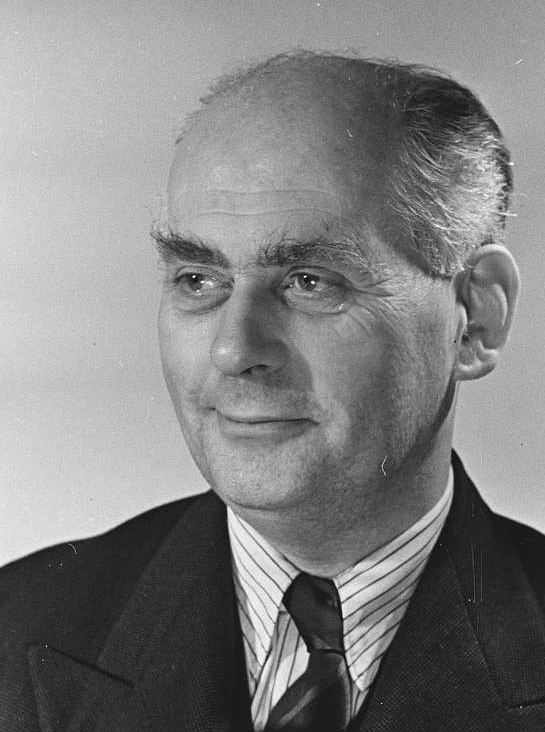
PELT, Adrianus (Adrian)
Dutch journalist and third Director of the Information Section of the League of Nations Secretariat 1934-1940
By Bob Reinalda · Version 25 June 2026
Was born on 8 May 1892 in Koog aan de Zaan, the Netherlands and died 11 April 1981 in Hermance, Switzerland. He was the son of Marinus Adrianus Pelt, mechanical engineer, and Dorothea Johanna Endt. On 3 February 1919 he married Andrée Elvire Léonide Bernard, with whom he had three daughters.
Biography
Pelt had no formal education beyond primary school level. After four years of secondary education, during which he displayed a good command of languages but not of mathematics, he left school without graduating. In 1909, aged 17, he chose journalism as his profession and gradually learned the trade. He worked for the newspaper Nieuwsblad voor Nederland. During the First World War he worked as a foreign correspondent, first for Het Nieuws van de Dag in London (1915-1916) and subsequently for De Telegraaf in Paris (1916-1919). He covered both military developments and the 1919 Peace Conference at Versailles. During his time living in Paris he combined his journalistic activities with studying diplomacy at the École libre des sciences politiques and married Andrée Bernard, a French woman who was born in Manchester, England. His attendance at the Peace Conference and connections with officials from the newly created League of Nations resulted in him attaining a position within the Information Section of the League’s Secretariat in April 1920. The Dutch Legal Section Director, Joost van Hamel, nominated Pelt, while Pierre Comert, the French Director of the Information Section, subsequently appointed him.
Pelt’s first mission was to report on the Washington Naval Conference (November 1921-February 1922). The conference was convened outside the League with the express aim of ending naval competition within the Pacific and served as an example for the League’s disarmament activities. When the League became responsible for Austrian finances through the establishment of an independent central bank and the stabilization of the Austrian currency in 1922, the League’s Council appointed the former mayor of Rotterdam, Alfred Zimmerman, as Commissioner-General for Austria along with a team of monetary, fiscal and publicity experts, with the latter intended to take over Austria’s information policy. The Information Section dispatched Pelt as a public relations officer with the assignment to put a positive spin on these reforms. The Section developed a work schedule and Pelt wrote weekly progress reports, urged journalists to visit Vienna, distributed press releases, drafted speeches for officials, established a mailing list of persons and institutions, distributed newspaper articles which could be used as blueprints for articles and charged the foreign offices of the Information Section in major countries with publishing articles on Austrian progress. He distributed summaries of Zimmerman’s League reports to the press and thus personalized the stabilization programme by connecting it to Zimmerman, who was not known for his diplomatic tact but nevertheless kept the mission going. If the news was insufficiently positive, then Pelt would delay providing updates to certain publications until there was better news to report. He successfully asked the Council of Churches in the United States (US) to help him with publishing information on Austria in the US press with the express purpose of informing the New York financial market. Pelt eventually succeeded in establishing a sophisticated strategy through which to disseminate ‘good news’ about Austria’s recovery, which, in turn, would reassure the markets (Clavin 2013: 28). In this respect, Pelt’s work ‘highlighted the new role of information as a major tool of League diplomacy’ (F. Beyersdorf in Laqua 2011: 140).
Although during the 1920s the new and energetic Information Section was granted considerable leeway, there were also restrictions pertaining to, on the one hand, engagement with public opinion (through the League’s information provision) and, on the other hand, national views articulated by governments that left little room for the press. While Section members Comert, Arthur Sweetser and Pelt saw the press as an important instrument through which to promote peace and understanding among the public, Secretary-General Eric Drummond placed constraints on the Section out of fear over accusations of international propaganda. The members of the Information Section believed that they could effectively improve the state of public opinion on the League by keeping in touch with journalists, academics and politicians, which they referred to as their ‘liaison activities’. Pelt explained that his years of experience in Dutch journalism had been ‘handy in creating the network he needed for his liaison work’ (Van Dijk 2022b: 54). Discussions on relations with the press within the Assembly in 1925 as well as pressure from European news agencies subsequently led the Information Section to organize the Conference on Press Experts in August 1927. Given his experience, Pelt helped organize the three preparatory committees on news agencies, governmental press departments and foreign correspondents. The conference, which was held under the League’s umbrella, represented ‘an excellent opportunity for the section to construct itself as an international authority on issues relating to the press’, if it maintained ‘a discreet background-role’ within the League (Seidenfaden 2024: 49). Two follow-up conferences (Copenhagen 1932, Madrid 1933) were focused on false news and how to counter such news, with the International Association of Journalists Accredited to the League of Nations urging for more transparency in diplomacy. The Section wanted to be more than a press bureau and reached out to various relevant groups. Pelt liaised with the International Union for Radio Broadcasting and began to elaborate his vision on the relevance of new technology as part of information provision. In 1929 he suggested that the Information Section should establish a radio service, which resulted in Radio Nations in 1932.
Pelt’s other international destinations for the Information Section included Greece and Hungary (1925), Germany (1927) and the Dutch East Indies (1930). After Japan’s attack on several cities in the Chinese province of Manchuria in September 1931, China called upon the League’s Council to act. Japan refused to withdraw but accepted a League Commission of Inquiry. Victor Lytton, the former British Governor of Bengal, led the League’s mission. The Lytton Commission sought to study the circumstances that threatened peace and good relations between China and Japan, but the body ultimately had limited powers. Pelt was added as secretary. The Lytton Commission left in January 1932 and visited Tokyo, Shanghai, Peking and Manchuria. The Commission’s report of September condemned Japan on all the essential points. The main report had several special reports attached, two of which were written by Pelt. One dealt with the financial situation in Manchuria, while the second report critically discussed the Chinese boycott campaign. Pelt saw this boycott as a successful weapon, insofar as Japanese exports to China had fallen sharply. However, he regarded this as a bad result for both countries, given their interdependence. The American economist Ben Dorfman, who had assisted Pelt during the inquiry, later wrote to him: ‘Your boycott study made a great hit in Japan and even foreign Chinese advisors (…) spoke well of it’ (quoted in Van Diepen 1999: 112). When waiting for transport from Manchuria, Japanese soldiers and Chinese civil servants invited Pelt to be the goalkeeper in a football match. He left his jacket, which had one of only three copies of the Commission’s report secretly sewn into the lining, behind the goal during the game and then picked it up afterwards. Before returning to Geneva, he explored the Asian region.
The League found itself operating within a changing political climate during the early 1930s due to its weaker position in international relations and the political upheaval taking place in Europe and Asia. The Assembly’s attitude towards the Information Section changed, as evidenced by its decision to reduce the Section’s budget and halve its staff. Germany pressured Comert to resign as Section Director as it wanted less French influence within the Secretariat after the Frenchman Joseph Avenol had been appointed as the League’s new Secretary-General on 1 July 1933. Sweetser was Acting Director in 1933, the year that the Information Section was subjected to the organizational changes. When Pelt was appointed as Director of the Information Section on 1 January 1934, he was ultimately responsible for implementing these changes. Pelt sensed that Comert’s information vision of the 1920s, which was carried out through the printed press and liaison activities, corresponded to the prevailing state of public opinion at that juncture. In light of emerging communication channels such as broadcasting and film, Pelt thought this vision had become outdated. In response, he focused on these emerging mass media forms of communication. Publications remained mostly untouched (although fewer staff were employed), but more resources were available for the Section’s now weekly radio broadcasts and, to some extent, films and photographs. The reorganization also reduced both the number of missions and travel budgets, with more precise and hierarchical administrative regulations being put in place. Despite this, the Section members continued their journalistic study of general national developments. Pelt visited the Scandinavian countries in 1936 and arranged for a member of the Disarmament Section to visit these same countries the following year. In 1936 he visited India, where he delivered lectures, had contacts with local governments, and discussed the relationship between the country and the League with politicians, including the leader of the nationalist movement, Jawaharlal Nehru. Pelt’s report on this mission amounted to more than 120 pages.
In 1939 the League’s Secretariat staff was again downsized. With the prospect of war on the horizon, Avenol’s leadership of the organization was wavering. Pelt was in the US as Commissioner-General of the League’s pavilion at the New York World’s Fair. Despite having agreed that Avenol was to speak at the World’s Fair, he had Pelt read his text. Avenol did not favour the plan to move the Secretariat’s economic section to Princeton in the US (which had happened on Sweetser’s initiative) and kept Pelt on his list of staff members from the Information Section who would remain in Geneva. However, when Germany occupied the Netherlands on 10 May 1940, Pelt stopped working for the League (but remained on the list of staff members until the end of the year). He left for London immediately to provide his services to the exiled Dutch government, as per his agreement with the Dutch Foreign Minister Eelco van Kleffens, who had worked at the League Secretariat in the early 1920s. After affirming his loyalty to the French Vichy government in July, Avenol resigned in August. Deputy Secretary-General Seán Lester, with whom Pelt had stayed in contact, kept the Secretariat and other League organs going.
In London Pelt reorganized the Dutch government’s press service into a full-scale information service and subsequently became its head. He established Radio Oranje as a daily broadcast service that would target the Dutch population who were under occupation. His agreement with the British Ministry of Information resulted in daily 15-minute radio bulletins that were designed to both sustain morale and send veiled messages to the resistance movements in the Netherlands since the end of July. Pelt was the first to launch such a national service. He also founded Radio Brandaris, which targeted Dutch seafarers, and a press agency which served as the free counterpart to the German-dominated press agency within the occupied territories. However, Wilhelmina, Queen of the Netherlands, then staying in London, did not necessarily appreciate Pelt and, in fact, considered him to be a stubborn little man. Indeed, for several months in 1944 she tried to block his appointment as Head of the Information Section of the Military Authority for the country’s liberated areas, but the exiled government held firm. Pelt served in this function from 18 September 1944 until 15 August 1945.
During the war the administrative experience of the League’s Secretariat was analysed in the US by former officials Alexander Loveday, Arthur Salter and Sweetser under the auspices of the Carnegie Endowment for International Peace, which organized two small conferences in August 1942 and January 1943. The same happened in London, where a group of former League officials, among them Drummond, Pelt, Frank Walters and also Comert, who had moved to London, met under the auspices of Chatham House to analyse their League experiences. This ‘London Group’ also wanted to contribute towards postwar international cooperation. This resulted in The International Secretariat of the Future (1944), mostly referred to as the London Report. Pelt added an appendix in which he expressed his vision of the modern information service, which included radio broadcasting, films and photographs. Pelt and Sweetser (in the US) corresponded about this aspect, with Sweetser valuing direct networking with prominent people, as the Information Section had practised during the 1920s, more than Pelt, who remained focused on the new communication technologies. Both Pelt and Sweetser attended the United Nations (UN) Conference on International Organization in San Francisco (April-June 1945) as delegation members of their own countries. In autumn the organizational aspects and staffing of the UN, including the new UN Department of Public Information (UNDPI), were discussed. Pelt became a member of the Technical Advisory Committee on Information (TACI), where he met former Information Section member Frédéric Blondel from Belgium and several other staff from the League Secretariat, while Sweetser advised TACI informally. Former League translator Vernon Duckworth-Barker led the UN’s provisional public information service. All of them kept their League affiliation mostly off the record, as the creators of the UN did not want the League to be mentioned. The League was entirely absent in the final report on information presented to UN Secretary-General Trygve Lie on 13 February 1946. However, the purposes of UNDPI largely reproduced Pelt’s vision from the London Report. UNDPI had the dual purpose of informing the public about UN activities and informing the Secretary-General about its standing in public opinion. Pelt’s focus on modern technology was adopted and there was a general taboo around propaganda. The only ‘liaison’ activity added by others was liaising with private collaborators, but mainly as a ‘system for providing stakeholder[s], activists or other interest groups with information’ (Seidenfaden 2024: 148).
In early 1946 Pelt was appointed as Assistant Secretary-General in charge of the organizationally significant UN Department of Conferences and General Services, which made him responsible for both the logistics and coordination of international meetings and around 650 staff members. He was also tasked with the transfer of relevant League of Nations files from Geneva to the UN in New York, which quickly proved to be a sensitive affair because the communication between Geneva and New York at the time required some tact. In November 1949 the General Assembly discussed the disposal of the former Italian colonies (Tripolitania and Cyrenaica, which were controlled by the British, and Fezzan, which was occupied by the French), which were to become an independent and sovereign Libyan state by no later than 1 January 1952. On 10 December Lie appointed Pelt as High Commissioner for Libya, with the assistance of a ten-person Council for Libya comprising foreign government representatives. Pelt had serious misgivings about his suitability for the job, on the grounds of his superficial knowledge of the area, the fact he was not a constitutional lawyer and his unfamiliarity with Arabic and the Islamic world. Given this, he assembled a large team of Secretariat employees to support his mission and added a reliable Englishman and Frenchman as well as an American to mediate between London and Paris. He avoided arriving by British or French aircraft by choosing the Dutch airline instead, although this had no landing rights in Libya, so the Director helped him out by having the flight to Johannesburg make an emergency stop in Tripoli due to severe weather. In cognisance of the fact that the British and the French had a hidden agenda against a strong central state, Pelt travelled widely through the three areas to both find out about the facts and circumstances and to make contacts. As a skilled communicator he solicited Libyan views on the country’s future and explained his UN function. The UN would neither govern Libya, nor impose a constitution on the country, but rather act in an advisory capacity. He saw the advice he provided to the Libyan people as being ‘impartial’, believing that it was not for him to decide but for the Libyans themselves (Muschik 2021: 83).
Pelt was concerned about the lack of both administrative and economic capacity for Libya’s impending sovereignty and initiated UN developmental surveys to find out what international assistance could be helpful for Libya. The General Assembly confirmed this broader understanding of his mandate and agreed with his decision to reach out to the UN specialized agencies in the fields of education and health. In fact, Pelt initiated ‘the first UN reconnaissance or preparatory mission to plan more comprehensive technical assistance for the country-in-the-making’ (Muschik 2021: 77). Both France and Britain, however, were reluctant to efficiently cooperate. The UN and its specialized agencies sent several missions to Libya but, according to Pelt, the Libyans saw the experts come and go without deriving much practical benefit from them. Herbert Broadly, Director-General of the Food and Agriculture Organization, agreed with Pelt that the most difficult challenge was the creation of a functioning state bureaucracy. The International Monetary Fund specialists suggested the creation of a central bank, but Britain succeeded in having Libya join the British Sterling bloc. Pelt remained pragmatic. When he found out that holding elections did not work, he let local leaders elect their own representatives. During the long time needed to write the constitution, he advised them by writing many letters full of warnings, advice and compromises. When the religious leader Sayyid Idris, supported by the British, preferred Cyrenaica to be an independent state, Pelt reminded Idris of the UN’s vision of creating a single state. He convinced Idris to agree to a federally united state, of which Idris would most probably become King. The constitution that was created was full of compromises, such as Libya having two capitals. The country became independent on 24 December 1951, so before the deadline, with Idris as King. The country’s sympathy towards Pelt was evidenced in the fact that he was nicknamed the ‘Viceroy of Libya’.
With support from the Carnegie Endowment, Pelt wrote a 1,016-page account of his Libyan experience (which was published as a book in 1970). His report helped the officials of the secretariats at the UN and its specialized agencies to ‘rethink the practice of state-building as going beyond the drafting of a constitution and forming a government’ (Muschik 2021: 70). In his discussions with Lie in May 1952 Pelt expressed concern that the new Libyan polity the UN had helped to create was especially weak. Regarding the question of applicability of the Libyan ‘model’ to other parts of Africa, he felt that the Libyan transformation was a unique international experiment in how to handle decolonization peacefully. However, his colleagues at UN headquarters and Paul Hoffman, who would later become Director of the UN Special Fund, did regard UN assistance to Libya as a model. According to Muschik (2021: 96) this set an ‘important precedent in presenting state-building increasingly as a technical challenge and an operational field for international experts rather than a political process’.
In 1952 Lie sent Pelt as his representative to the International Labour Conference in Geneva as well as the Universal Postal Congress in Berne and appointed him as Director of the European Office of the UN in the old League building in Geneva. Pelt succeeded Wlodimierz Moderow, the Polish Director who represented the Secretary-General at the UN Office at Geneva, with whom he had arranged the transfer of League documents in 1946. Pelt remained in this position until December 1957, when he retired. He continued to perform various functions, such as being General Secretary of the World Federation of the United Nations Associations and a board member of both a Dutch heart foundation and the International Heart Institute in Geneva. He died in Switzerland in 1981, at the age of 89. Pelt was a pioneer in the development of information provision by both the League of Nations and the UN, and he was one of the first to engage in state building via international cooperation.
Archives
- Collectie 582 A. Pelt in Nationaal Archief, The Hague, the Netherlands, www.nationaalarchief.nl/onderzoeken/archief/2.21.281.29
- Sub-Fonds – Pelt, Adrianus in United Nations Library & Archives Geneva, https://archives.ungeneva.org/pelt-adrianus-2
Publications
- ‘Foreword’ in I.R. Khalidi, Constitutional Development in Libya, Beirut 1956, vii-xi
- Libyan Independence and the United Nations: A Case of Planned Decolonisation, New Haven 1970
Literature
- E.F. Ranshofen-Wertheimer, The International Secretariat: A Great Experiment in International Administration, Washington 1945
- L. Adam, Een staat werd geboren: Libië, Leiden 1952
- T. Lie, In the Cause of Peace: Seven Years with the United Nations, New York 1954
- J. Barros, Betrayal from Within: Joseph Avenol, Secretary-General of the League of Nations, 1933-1940, New Haven 1969
- A.W. Rovine, The First Fifty Years: The Secretary-General in World Politics 1920-1970, Leiden 1970
- R.B. Fosdick, The League and the United Nations: The Six Secretaries-General, Newton 1972
- J. Bosmans, De Nederlander mr. A.R. Zimmerman als commissaris-generaal van de Volkenbond in Oostenrijk 1922-1926, Nijmegen 1973
- L. de Jong, Het Koninkrijk der Nederlanden in de Tweede Wereldoorlog, Deel 9, Den Haag 1979
- E.N. van Kleffens, Belevenissen I 1894-1940, Alphen aan den Rijn 1980
- NRC Handelsblad, 23 April 1981
- E.N. van Kleffens, Belevenissen II 1940- 1958, Alphen aan den Rijn 1983
- J. Bosmans, ‘Pelt, Adrianus (1892-1981)’ in Biografisch Woordenboek van Nederland 2, The Hague 1985, 448-450
- M.A. Balinska, For the Good of Humanity: Ludwik Rajchman Medical Statesman, Budapest 1998
- R. van Diepen, Voor Volkenbond en vrede: Nederland en het streven naar een nieuwe wereldorde 1919-1946, Amsterdam 1999
- M. Riemens, De passie voor vrede: De evolutie van de internationale politieke cultuur in de jaren 1880-1940 en het recipiëren door Nederland, Amsterdam 2005
- H. Tworek, ‘Peace through Truth – The Press and Moral Disarmament through the League of Nations’ in Medien & Zeit, 25/4, 2010, 16-28
- D. Laqua (Ed.), Internationalism Reconfigured: Transnational Ideas and Movements between the World Wars, London 2011
- P. Clavin, Securing the World Economy: The Reinvention of the League of Nations 1920-1946, Oxford 2013
- E. Tollardo, Fascist Italy and the League of Nations, 1922-1935, London 2016
- L. Kwarten, ‘Adrian Pelt: The Viceroy of Libya’ in Elsevier Weekly, January 2018 (originally Elsevier Weekblad, 27 January 2018, 44-45)
- D. Macfadyen et al., Eric Drummond and his Legacies: The League of Nations and the Beginnings of Global Governance, Cham 2019
- K. Gram-Skjoldager, H.A. Ikonomou and T. Kahlert (Eds), Organizing the 20th-Century World: International Organizations and the Emergence of International Public Administration, 1920-1960s, London 2020
- E.-M. Muschik, Building States: The United Nations, Development, and Decolonization, 1945-1965, New York 2021
- P. van Dijk, ‘We Must Work with a Missionary Spirit’: The League of Nations Information Section and Public Diplomacy, Florence 2022a
- P. van Dijk, ‘Conducting Diplomacy for the League: The Missions of Secretariat Officials’ in Administory, 7, 2022b, 52-66
- E.J. Ravndal, In the Beginning: Secretary-General Trygve Lie and the Establishment of the United Nations, Bristol 2023
- J. Mumby, Dismantling the League of Nations: The Quiet Death of an International Organization, London 2024
- E.E. Seidenfaden, Informing Interwar Internationalism: The Information Strategies of the League of Nations, London 2024
(all websites accessed 12 February 2026)
How to cite
Bob Reinalda, 'Pelt, Adrianus' in IO BIO, Biographical Dictionary of Secretaries-General of International Organizations , edited by Bob Reinalda, Kent J. Kille and Jaci L. Eisenberg. https://sandbox.zenodo.org/records/604356 (sandbox preview)
Text © the author(s) and IO BIO, licensed under CC BY-NC-ND 4.0. The portrait is excluded and remains under the rights of its credited source. We have tried to trace the rights holder to obtain permission for the use of the portrait, but contact us in case we have failed.