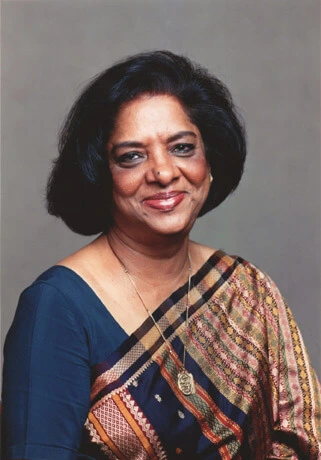
SADIK, Iffat Nafis
Pakistani obstetrician and second Executive Director of the United Nations Population Fund (UNFPA) 1987-2000
By Chloé Maurel · Version 1 October 2026
Was born 18 August 1929 in Jaunpur, British India and died 14 August 2022 in New York City. She was the daughter of Mohamed Shoaib, Pakistani Minister of Finance and representative in the World Bank, and Iffat Ara. On 11 May 1954 she married Azhar Sadik, army officer and businessman, with whom she had two daughters and one son as well as two adopted daughters.
Biography
Sadik was born into a distinguished Muslim family. Following the partition of British India in 1947, the family settled in the newly independent state of Pakistan. Her father was a civil servant who developed an international political-financial career. He became Pakistan’s Minister of Finance (1958-1966) as well as Executive Director of the International Bank for Reconstruction and Development (IBRD) in the United States (US) (1952-1963), where he also represented several Middle Eastern countries as Governor for Pakistan in the IBRD (1958-1962) and served as IBRD Vice President (1966-1975). In school Sadik loved engineering, medicine and Indian classical music. She was good in badminton, tennis and bridge. At a time when relatively few women in South Asia pursued advanced professional careers, she chose to study medicine. Her mother was reluctant and preferred her to get married. Sadik also feared opposition from her father, but he was supportive and accompanied her for her interview at Loretto Medical College in Calcutta, India. After her education in India, she graduated with a Doctor of Medicine degree from Dow Medical College in Karachi, one of Pakistan’s leading medical institutions, in 1951. She then moved to the US to study gynaecology and obstetrics at Johns Hopkins University in Baltimore (1952-1954), also serving an internship at the City Hospital there. In 1953 she had a traditional Muslim wedding with army officer Azhar Sadik at the Pakistan embassy in Washington DC. In 1954 they returned to Pakistan, where she became a civilian doctor in Pakistani Armed Forces hospitals, serving in women’s and children’s wards. She did so until 1963, with time spent away as a research fellow in physiology at Queens University in Kingston, Canada in 1958.
Sadik’s early professional experience as a physician influenced her later career. Working in hospitals and rural communities, she witnessed first-hand the consequences of inadequate maternal health services, high maternal mortality, unintended pregnancies and limited access to family planning. Noticing the high numbers of children per family made her aware of the relevance of family planning. As there were no such services, she decided to start one and asked her commanding officer for money to buy contraceptives. He nearly fell out of his chair in reaction to the request but finally gave her the money. She then went to the villages and talked to husbands about family planning. First, they were ‘a bit shocked’, but they also understood that she was very determined (Los Angeles Times, 4 September 1994). These experiences convinced her that women’s health and reproductive autonomy were essential components of economic and social development. Long before such ideas became accepted in international policy circles, she argued that population policies could not succeed unless women themselves were empowered through education, healthcare and access to reproductive services.
In 1963 Sadik took a three-month break, trying to live without working. However, this was not a success. She returned to Johns Hopkins University in the US to study public health and health planning. In 1964 Sadik went back to Pakistan to enter its public service. She became Head of the Health Section of the national Planning Commission and helped to develop a national five-year programme. Two years later she joined the Pakistan Central Family Planning Council, the government body responsible for implementing the country’s family planning programme. After serving as Director of Planning and Training she became Deputy Director-General in 1968 and was appointed Director-General in 1970. In this capacity she supervised one of the largest family planning programmes in the developing world at the time and acquired extensive experience in the design and management of population policies.
Sadik joined the United Nations (UN) Fund for Population Activities (UNFPA) as a technical advisor in October 1971. Back in December 1966 the UN General Assembly had called for the creation of a programme to address population concerns, underlining the principle that the size of the family should be the free choice of every individual family. In July 1967 UN Secretary-General U Thant established the UN Trust Fund for Population Activities. Since 1969 UNFPA operated under the administration of the UN Development Fund out of concern about the rapid population growth in the South but also based in hope for new family technologies. Its operations were part of the discussions at the International Conference on Human Rights in Tehran, Iran in April 1968, which agreed on the basic right of parents to determine freely and responsibly the number and the spacing of their children, also highlighting the relationship between family planning and the status of women. Since 1969 UNFPA was led by Executive Director Rafael Salas from the Philippines, who tried to bring together both developed and less developed states. In 1971 UNFPA was recognized as a permanent entity under the authority of the UN General Assembly and funded through voluntary contributions from member states. Sadik rose through the ranks of the young institution, becoming Chief of the Programme Division in 1973 and Assistant Executive Director in 1977. Her administrative abilities, technical expertise and awareness of the necessity of scientific study made her influential within the organization. In 1968 she also joined the International Union for the Scientific Study of Population and was an active member of its Council between 1977 and 1981. In 1978 UNFPA published The State of World Population for the first time. This annual report helped to understand and follow the world’s changing demographics. The report focused on catching the global challenges in sexual and reproductive health and rights. Sadik would travel to various member states to discuss the trends UNFPA observed, arguing that conscious women curb population growth.
When Executive Director Salas died unexpectedly in early March 1987, UN Secretary-General Javier Pérez de Cuéllar appointed Sadik as Salas’s successor on 2 April. She became the first woman selected to head one of the UN’s major programmes and was one of the highest-ranking women in the entire UN System, as she also held the rank of Under-Secretary-General. At a time when senior leadership positions in international organizations remained occupied by men, her appointment embodied a breakthrough for women’s representation within global governance, promoted by the UN conferences on women in 1975 (Mexico City), 1980 (Copenhagen) and 1985 (Nairobi). As Executive Director Sadik oversaw a period of major expansion and transformation. UNFPA became the world’s principal source of multilateral assistance for population and reproductive health programmes, by 1994 operating in more than 140 states and territories. By that point Sadik directed a worldwide staff of 800, with a yearly budget of 250 million dollars from a variety of donors. Forty-four per cent of the UNFPA managers were women.
During Sadik’s tenure UNFPA increasingly emphasized that demographic issues could not be separated from the social and economic conditions of individuals, particularly women. Her approach gave greater prominence to women’s access to family planning, maternal health and participation in development policy, while population issues were linked to broader questions of human development, gender equality, education and human rights. This orientation reflected Sadik’s earlier professional background. She consistently argued that population policies should not focus narrowly on demographic targets but rather on improving the lives and choices of individuals. She insisted that women’s rights were central to sustainable development. During previous decades, international population policies often emphasized demographic objectives such as reducing fertility rates. Sadik helped shift the focus toward education, reproductive rights, maternal health and individual choice. She argued that if women had access to education, healthcare and family planning, demographic change would follow naturally. The year 1987 was an important moment in international population policy. On 11 July the world population reached the figure of five billion people, an event that UNFPA used to raise international awareness of demographic change. This led to the establishment of World Population Day, subsequently observed every year on that day. On 11 December 1987 the UN General Assembly officially changed the name of the UN Fund for Population Activities into UN Population Fund but retained the abbreviation UNFPA.
The years 1987-1994 can be regarded as a transitional period for UNFPA. The organization continued its established work in family planning, demographic data and population assistance, but Sadik made UNFPA increasingly frame its activities in terms of women’s health, individual choice and development. This evolution prepared the institutional and political ground for the decisive change represented by the 1994 Cairo Programme of Action. In June 1990 UN Secretary-General Javier Pérez de Cuéllar appointed Sadik as Secretary-General of the International Conference on Population and Development. He entrusted her with the responsibility of organizing this event. The conference was held in Cairo, Egypt from 5 to 13 September 1994 and brought together representatives from 179 states, several international organizations and thousands of non-governmental organizations (NGOs). The Cairo Conference would transform global thinking on population and development issues. Sadik oversaw a global shift in sexual and reproductive health care, with a focus on ‘individual human rights and needs as opposed to national or international numerical goals’. She argued that ‘healthy families are created by choice, not by chance’ (Kirkegaard 2022). The draft programme emphasized ‘reduction of the need for abortion by providing reproductive health services, including family planning’ (Green 2022: 882). The Cairo Conference adopted a Programme of Action that placed human rights, reproductive health, women’s empowerment and gender equality at its centre. The Programme’s significance lay in redefining population policy. Rather than making demographic reduction the principal objective, it placed individual well-being, reproductive health, reproductive rights, women’s empowerment, education and development at the centre of population policy. The Programme called for universal access to reproductive-health care, including family planning, maternal health services and prevention and treatment of sexually transmitted infections and also addressed issues such as adolescent reproductive health, gender equality, violence against women and the relationship between population, poverty, development and the environment. UNFPA subsequently made implementation of the Cairo Programme of Action a major component of its work.
Since 1994 UNFPA and other international bodies ‘have worked toward providing women with greater access to secondary and higher education, decreasing infant and child death, and increasing access to sexual and reproductive health services, including family planning’ (Kirkegaard 2022). The Cairo Conference broke the taboo of discussing sexuality publicly. Sadik’s plan to give all women access to modern methods of birth control and the right to choose whether and when to become pregnant also provoked controversy. Several states, Pope John Paul II and some Muslim leaders opposed the whole agenda, saying that the Conference ‘will promote abortion, birth control and promiscuity’. In an interview Sadik thanked the Pope for all his publicity: ‘It’s helpful’ (Los Angeles Times, 4 September 1994). Sadik’s vision and results in Cairo continued at the UN’s Fourth World Conference on Women in Beijing, China in September 1995 and can also be found in the UN development goals since 2000. Her work at the Beijing conference connected UNFPA’s population agenda with the broader international movement for women’s rights and gender equality. Sadik participated prominently in the discussions and argued that reproductive rights had to be understood in relation to women’s wider social and economic position. She emphasized reproductive rights as extending beyond the mere right to reproduce and involving women’s freedom to participate fully in social and economic life.
UNFPA increasingly integrated reproductive health and family planning rather than treating contraception as an isolated population control instrument. The organization supported the expansion of contraceptive choices and training for service providers in Central Asia. At a 1996 regional meeting in Almaty, Kazakhstan Sadik emphasized the progress made by governments, international organizations and NGOs in adopting the organization’s reproductive-health approach. UNFPA promoted partnerships between governments, NGOs and the private sector. A particularly important operational development concerned contraceptive commodities. Following a decision of its Executive Board in 1997, UNFPA established the Global Contraceptive Commodity Programme to improve the availability of contraceptive supplies. In 1998 the Programme expanded its stocks beyond condoms to include oral contraceptives and intrauterine devices. UNFPA also worked with member states to strengthen national logistics systems and prevent shortages. The organization’s 1998 annual report records work in countries such as India, Kazakhstan, Uzbekistan and Viet Nam, while cooperation with governments, donors and private manufacturers was used to improve procurement and distribution. The same period saw an increasing emphasis on adolescents and young people. By 1999 UNFPA was supporting governments in reaching both in-school and out-of-school young people with reproductive health information and services. HIV/AIDS also became an increasingly prominent component of the UNFPA work. Given the rapid spread of HIV/AIDS among young people, UNFPA’s 1999 annual report showed concern and stressed the need for access to preventive methods and information. UNFPA’s mandate also expanded in response to war, displacement and humanitarian crises. Following the Cairo Conference, the organization increasingly addressed reproductive-health needs among refugees and populations affected by conflict. By 1998-1999 it worked to build an expanded response to reproductive health needs in conflict and other crisis situations, such as in Armenia, Bosnia and Herzegovina, Croatia, Georgia and the Russian Federation. During the 1990s Sadik joined several institutions, among them the Foundation for Human Development (member of the Board of Governors), the Society for International Development (President, 1994-1997), the South Asian Commission on the Asian Challenge and the Association of Physicians of Pakistani Descent of North America.
On 1 January 2001 Thoraya Obaid from Saudi Arabia became Sadik’s successor as UNFPA Executive Director. Obaid was the first Saudi woman to receive a state scholarship to study English in the US and had joined UNFPA as Director of the Division for Arab States and Europe. Sadik retired but continued her association with the UN and remained active in the international population and development field. She became Special Adviser to UN Secretary-General Kofi Annan, who appointed her as his Special Envoy for HIV/AIDS in Asia and the Pacific in May 2002. She became responsible for promoting the Declaration of Commitment on HIV/AIDS throughout Asia, a document adopted by the General Assembly’s Special Session on HIV/AIDS in July 2001. Sadik worked closely with UNAIDS. In 2003 she was designated as UNFPA’s Goodwill Ambassador for Obstetric Fistula. Furthermore, she worked as a member of Annan’s High-Level Panel on Threats, Challenges and Change and his High-Level Group for the United Nations Alliances of Civilizations. She also was a Commissioner of the Global Commission on International Migration, a member of the International Task Force on Global Public Goods and a Trustee of the International HIV/AIDS Alliance. In these roles and through speeches she continued to advocate for public health, women’s rights and international cooperation. Her contributions and leadership were widely recognized through numerous international honours and awards.
Sadik died of natural causes in New York City in August 2022, four days before her ninety-third birthday. Tributes from the UN, international organizations and governments highlighted her pioneering role in advancing women’s health and rights. UN Secretary-General António Guterres described her as a trailblazer who consistently emphasized the importance of involving women directly in development policy and implementation. Sadik’s tenure at UNFPA constituted a pivotal period in the history of global population policy, marking a gradual transition from a paradigm largely shaped by concerns over rapid population growth and the perceived risks of a population explosion (and therefore many efforts to curb fertility and population growth) to a very different contemporary demographic landscape, with developed countries facing persistently low fertility, population ageing and, increasingly, population decline. This makes the challenge of slowing or reversing demographic decline a growing policy concern. As a physician Sadik helped bring medical expertise into international population policy. As a specialist in international population and reproductive health policies, she helped transform global approaches to family planning, women’s rights and development. Through the 1994 Cairo Conference she contributed to a paradigm shift that linked population policy with human rights and sustainable development. As Executive Director of UNFPA she transformed the organization into a leading advocate for reproductive health and women’s empowerment. Her approach influenced international development thinking during the 1990s and as the first woman to lead one of the UN’s major voluntarily funded programmes, Sadik opened new paths for women’s leadership within international organizations.
Publications
- Population: The UNFPA Experience, New York 1984 (Editor)
- The State of World Population, 1988, New York 1988
- Safeguarding the Future, New York 1989
- Investing in Women: The Focus of the 1990s, New York 1990
- Population Policies and Programmes: Lessons Learned from Two Decades of Experience, New York 1991 (Editor)
- The State of World Population, 1991, New York 1991
- The State of World Population, 1992, New York 1992
- Making a Difference: Twenty-five Years of UNFPA Experience, London 1994 (Editor)
- Population and Development: New Research Priorities after the Cairo and Beijing Conferences, The Hague 1996
- State of World Population, The Lives Together, Worlds Apart – Men and Women in a Time of Change, New York 2000
- Feeding the World, Sustaining the Earth: The Critical Importance of Population Issues, Montpellier 2001
- An Agenda for People: UNFPA Through Three Decades, New York 2002 (Editor)
- Investing in Peace: Demography, Gender and Reproductive Health, Guelph 2002. LITERATURE: ‘Fighting Population With Women’s Rights: Meeting: Nafis Sadik Has Spent Years Promoting Family Planning: The Head of this Week’s U.N. Conference Sees Equality as Key to Controlling World’s Numbers’ in Los Angeles Times, 4 September 1994
- International Union for the Scientific Study of Population, ‘IUSSP Laureate 1994. Nafis Sadik’ at https://iussp.org/en/iussp-laureate-1994-nafis-sadik
- S. Johnson, The Politics of Population: The International Conference on Population and Development, Cairo 1994, London 1995
- M.S. Hartman (Ed.), Talking Leadership: Conversations with Powerful Women, New Brunswick 1999, 201-216
- R. Sharpless, Population and Reproductive Health: Oral History Project, Northampton 2006, Interview 24 July 2003, Sophia Smith Collection, Smith College, see www.smith.edu/libraries/libs/ssc/prh/transcripts/camp-trans.pdf)
- C. Maurel, Histoire des idées des Nations unies, Paris 2015
- C. Maurel, Une brève histoire de l’ONU au fil de ses dirigeants, Vulaines-sur-Seine 2017
- United Nations Population Fund, An Agenda for People: The UNFPA Through Three Decades, New York 2002
- R.S. Robinson, UNFPA in Context: An Institutional History: Background Paper prepared for the Center for Global Development Working Group on UNFPA’s Leadership Transition, Washington DC 2010
- Columbia University Programs and Events Planning Resources, World Leaders Forum, ‘Nafis Sadik’, June 2006, at https://worldleaders.columbia.edu/directory/nafis-sadik
- ‘Nafis Sadik, Women’s Health and Rights Champion, Dies at 92’ in US News, 15 August 2022
- ‘Former UNFPA Executive Director, UN Under-Secretary-General’, Obituary at www.unfpa.org/about/nafis-sadik, 18 August 2022
- ‘Nafis Sadik, U.N. Official and “Proud Champion of Choice,” Dies at 92’ in The New York Times, 19 August 2022
- A. Green, ‘Obituary Nafis Sadik’ in The Lancet, 400/10356, 17 September 2022, 882
- D. Kirkegaard, ‘Champion of Human Rights and Former UNFPA Executive Director, Dr. Nafis Sadik, Passes Away at 92’ at USA for UNFPA, September 2022, www.usaforunfpa.org/champion-human-rights-former-unfpa-executive-director-dr-nafis-sadik/
- C. Miller, Champion of Choice: The Life and Legacy of Women’s Advocate Nafis Sadik, Lincoln 2022 (all websites accessed on 10 July 2026). Chloé Maurel
Literature
- ‘Fighting Population With Women’s Rights: Meeting: Nafis Sadik Has Spent Years Promoting Family Planning: The Head of this Week’s U.N. Conference Sees Equality as Key to Controlling World’s Numbers’ in Los Angeles Times, 4 September 1994
- International Union for the Scientific Study of Population, ‘IUSSP Laureate 1994. Nafis Sadik’ at https://iussp.org/en/iussp-laureate-1994-nafis-sadik
- S. Johnson, The Politics of Population: The International Conference on Population and Development, Cairo 1994, London 1995
- M.S. Hartman (Ed.), Talking Leadership: Conversations with Powerful Women, New Brunswick 1999, 201-216
- R. Sharpless, Population and Reproductive Health: Oral History Project, Northampton 2006, Interview 24 July 2003, Sophia Smith Collection, Smith College, see www.smith.edu/libraries/libs/ssc/prh/transcripts/camp-trans.pdf)
- C. Maurel, Histoire des idées des Nations unies, Paris 2015
- C. Maurel, Une brève histoire de l’ONU au fil de ses dirigeants, Vulaines-sur-Seine 2017
- United Nations Population Fund, An Agenda for People: The UNFPA Through Three Decades, New York 2002
- R.S. Robinson, UNFPA in Context: An Institutional History: Background Paper prepared for the Center for Global Development Working Group on UNFPA’s Leadership Transition, Washington DC 2010
- Columbia University Programs and Events Planning Resources, World Leaders Forum, ‘Nafis Sadik’, June 2006, at https://worldleaders.columbia.edu/directory/nafis-sadik
- ‘Nafis Sadik, Women’s Health and Rights Champion, Dies at 92’ in US News, 15 August 2022
- ‘Former UNFPA Executive Director, UN Under-Secretary-General’, Obituary at www.unfpa.org/about/nafis-sadik, 18 August 2022
- ‘Nafis Sadik, U.N. Official and “Proud Champion of Choice,” Dies at 92’ in The New York Times, 19 August 2022
- A. Green, ‘Obituary Nafis Sadik’ in The Lancet, 400/10356, 17 September 2022, 882
- D. Kirkegaard, ‘Champion of Human Rights and Former UNFPA Executive Director, Dr. Nafis Sadik, Passes Away at 92’ at USA for UNFPA, September 2022, www.usaforunfpa.org/champion-human-rights-former-unfpa-executive-director-dr-nafis-sadik/
- C. Miller, Champion of Choice: The Life and Legacy of Women’s Advocate Nafis Sadik, Lincoln 2022 (all websites accessed on 10 July 2026). Chloé Maurel
How to cite
Chloé Maurel, 'Sadik, Iffat Nafis' in IO BIO, Biographical Dictionary of Secretaries-General of International Organizations , edited by Bob Reinalda, Kent J. Kille, Jaci L. Eisenberg, Ellen Ravndal and Dawisson Belém Lopes. https://sandbox.zenodo.org/records/611858 (sandbox preview)
Text © the author(s) and IO BIO, licensed under CC BY-NC-ND 4.0. The portrait is excluded and remains under the rights of its credited source. We have tried to trace the rights holder to obtain permission for the use of the portrait, but contact us in case we have failed.