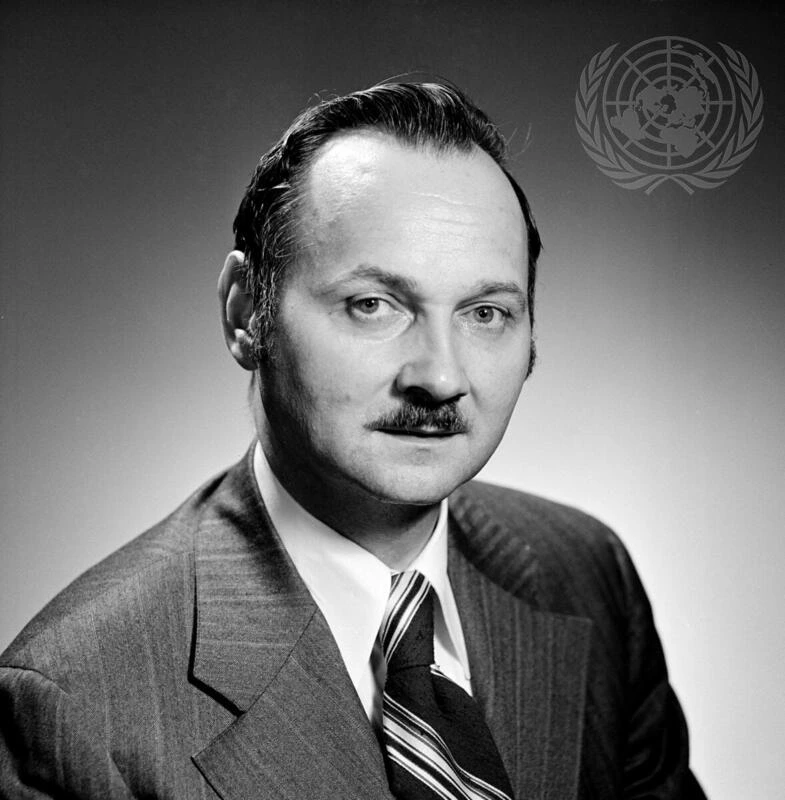
STRONG, Maurice Frederick
Canadian businessman and first Executive Director of the United Nations Environment Programme (UNEP) 1973-1975
By Chloé Maurel · Version 18 November 2026
Was born 29 April 1929 in Oak Lake, Manitoba, Canada and died 28 November 2015 in Ottawa, Canada. He was the son of Frederick Milton Strong, railway telegraph operator, and Mary Fyfe, teacher. On 29 July 1950 he married Pauline Olivette, teacher, with whom he had two daughters and two sons. After their divorce in 1980 he married Hanne Marstrand, interior designer, journalist and environmental and philanthropic leader, with whom he had one foster daughter, in 1981.
Biography
Strong was raised during the Great Depression of the 1930s. He received little formal education and never attended university. At the age of fourteen he left school and began working in a variety of occupations before joining the Calgary-based Power Corporation group. In 1947 Strong met a leading United Nations (UN) official, who arranged a temporary, very low-level appointment for him. He worked as a junior security officer for the UN Secretariat at UN Headquarters in Lake Success, New York (1947-1948). On his return to Canada he went into industry and, during the 1950s, built a successful career in the Canadian oil and energy sector, becoming one of the country’s youngest corporate executives. His entrepreneurial success enabled him to develop an extensive network within Canadian political and business circles, including future Prime Ministers Lester Pearson and Pierre Trudeau.
Strong’s growing interest in international affairs coincided with Canada’s increasing involvement in multilateral diplomacy during the post-war period. During the 1960s he served in several advisory capacities for the Canadian government, notably in the fields of international development and foreign assistance. Strong came from the oil and business sectors, but Prime Minister Pearson appointed him to head Canada’s External Aid Office in 1966 because of his managerial and entrepreneurial abilities, his political and business networks and his longstanding interest in international affairs and development, which had brought him to the attention of both Pearson and Foreign Minister Paul Martin Sr. Although Strong remained in office for only two years, he advocated for closer links between economic development, natural resource management and international cooperation, themes that would subsequently define his international career. His work at the Canadian International Development Agency, the new name of the External Aid Office, enabled him to return to the UN as a Canadian delegate. There he established relations with the UN Development Programme (UNDP), then headed by Paul Hoffman. Between 1966 and 1970 Strong was also Canada’s Alternate Governor at the International Bank for Reconstruction and Development, the Asian Development Bank and the Caribbean Development Bank.
Strong’s reputation as an effective administrator and consensus-builder led UN Secretary-General U Thant to appoint him Secretary-General of the UN Conference on the Human Environment, held in Stockholm, Sweden from 5 to 16 June 1972. The conference represented the first global summit devoted exclusively to environmental issues and brought together representatives of 113 states, nineteen intergovernmental organizations and hundreds of non-governmental organizations (NGOs). Strong played a central role in preparing both the conference and the political compromises that made it possible. He commissioned Barbara Ward and René DuBos to write a document that would provide the intellectual framework for the conference. Their Only One Earth text promoted international responsibility, while states submitted national reports on environmental issues. Strong sought to overcome the opposition between industrialized countries, primarily concerned with pollution, and developing countries, which feared that environmental protection could become an obstacle to economic growth. Under Strong’s leadership the conference culminated in the adoption of the 1972 Stockholm Declaration. This text, comprising twenty-six principles, together with an Action Plan containing 109 recommendations, became a seminal document in the development of international environmental law. Principle 21, affirming the sovereign right of states to exploit their own resources while assuming responsibility not to cause environmental damage beyond their borders, became one of the foundations of modern international environmental law. Although the Conference did not produce legally binding obligations, it firmly established environmental protection as an issue to be addressed in the UN System. One of Strong’s greatest achievements in Stockholm was persuading governments that environmental questions required a permanent institutional framework within the UN. Following recommendations adopted at Stockholm, the UN General Assembly established the UN Environment Programme (UNEP) by Resolution 2997(XXVII) on 15 December 1972.
Strong’s environmental awareness had developed through his experiences in the Canadian resource industry and in international aid. He had observed pollution and the social and ecological impacts of development projects and had read Rachel Carson’s Silent Spring (1962), which documented the environmental harm by pesticides. His early UN connections and relationships included figures such as Swedish diplomat Sverker Åström, who contributed to environmental thought in Stockholm, Ward, the early advocate of sustainable development, and Aurelio Peccei, the Italian industrialist and co-founder of the Club of Rome in 1968. These contacts helped shape his trajectory from business to international environmental diplomacy. Thant appointed Strong to head UNEP, given his proven organizational and leadership skills, political pragmatism, international development experience and ability to bridge the concerns of both industrialized and developing countries. The bold decision to locate UNEP headquarters in Nairobi, Kenya, rather than in Europe or North America, reflected Strong’s conviction that environmental governance should not be dominated by industrialized countries and that developing countries had to participate fully in shaping the global environmental agenda. UNEP thus became the first major UN organization headquartered in the developing world.
On 1 January 1973 Strong started as the first Executive Director of UNEP. His principal task consisted of creating an entirely new international institution with limited financial and political resources. Unlike UN specialized agencies such as the International Labour Organization (ILO) or the World Health Organization (WHO), UNEP is a ‘programme’, like the UNDP. UNEP depends on voluntary contributions to its Environment Fund and possesses no treaty-making authority of its own. Strong therefore sought to maximize UNEP’s influence through scientific expertise, international coordination and catalytic action rather than through regulatory powers. Under his leadership, UNEP rapidly established itself as the central environmental institution within the UN System. The organization created the Earthwatch programme to improve global environmental monitoring, as well as strengthening cooperation with the World Meteorological Organization, the Food and Agriculture Organization and the UN Educational, Scientific and Cultural Organization (UNESCO) and promoting the development of regional sea programmes. UNEP also played an important coordinating role during negotiations leading to the Convention on International Trade in Endangered Species of Wild Fauna and Flora (CITES), signed in Washington DC in March 1973. The organization also supported the implementation of the Convention concerning the Protection of the World Cultural and Natural Heritage, adopted by UNESCO in November 1972.
Strong consistently argued that environmental protection and economic development were mutually reinforcing rather than contradictory objectives. At a time when many developing countries regarded environmental policies as a potential constraint on industrialization, he insisted that poverty itself constituted one of the principal causes of environmental degradation. This approach, already visible during the Stockholm Conference, anticipated later discussions on sustainable development by emphasizing the interdependence of environmental protection, economic growth and social progress. Despite UNEP’s rapid institutional consolidation, Strong also encountered important constraints. Several industrialized countries remained reluctant to provide substantial financial resources, while many developing countries feared that environmental concerns might divert attention from questions of development and international economic inequality. Moreover, UNEP’s mandate remained essentially coordinative, limiting its capacity to influence the policies of other organizations within the UN System. These institutional limitations would continue to shape global environmental governance long after Strong’s departure from UNEP. Strong did not remain in office for a long period, departing in December 1975, with Mostafa Tolba from Egypt taking over as his successor as Executive Director of UNEP. Strong maintained close personal and professional relationships with several successive Executive Directors of UNEP, particularly Tolba, whom he had appointed Deputy Executive Director in 1973, but also with Elizabeth Dowdeswell (1993-1998), Klaus Töpfer (1998-2006) and Achim Steiner (2006-2016), notably through international environmental diplomacy and UNEP policy and commemorative events.
After leaving UNEP Strong returned to Canada, where Prime Minister Trudeau appointed him President of the Petro-Canada company (1976-1978), the newly created state-owned oil company established in the aftermath of the 1973 oil crisis. Strong was also Chairman of the Board and Chairman of the Executive Committee at the same time. His acceptance of this position appeared paradoxical and even contradictory to some environmentalists, who criticized the inconsistency between his environmental commitments and his leadership of a major petroleum company. Strong, on the other hand, argued that the transition towards more sustainable patterns of development required engagement with, rather than opposition to, the energy sector. During the following decade he combined business activities with numerous advisory roles in international development and environmental policy. This has exposed him to some criticism, alleging potential conflicts of interest and a questionable blurring of the boundaries between the public and private sectors.
Throughout the 1980s Strong remained closely associated with the UN. He served on the World Commission on Environment and Development, chaired by Gro Harlem Brundtland, between 1984 and 1987. Although not one of the Commission’s principal authors, he contributed to the worldwide discussions that culminated in the publication of Our Common Future (1987). This seminal report popularized the key-concept of ‘sustainable development’, defined as development that meets ‘the needs of the present without compromising the ability of future generations to meet their own needs’ (UN 1987: 11). The report strongly influenced subsequent UN environmental diplomacy and provided the intellectual basis for the next major global conference. Strong also volunteered for the International Union for the Protection of Nature, an independent organization initiated by UNESCO in 1948. Over all these years he maintained an extensive network with influential figures across business, environmentalism and international organizations, including Robert Anderson, David Rockefeller and Stephan Schmidheiny from the business world, Klaus Schwab of the World Economic Forum, Brundtland, Dubos and Ward from intellectual and environmental circles and UN leaders such as Thant and Kofi Annan.
In December 1988 the UN General Assembly decided to convene the UN Conference on Environment and Development (UNCED). In 1989 UN Secretary-General Javier Pérez de Cuéllar appointed Strong as Secretary-General of UNCED. During the following three years Strong directed one of the largest diplomatic preparations undertaken by the UN, involving more than 170 governments, dozens of international organizations and several thousand representatives of scientific institutions, business organizations and NGOs. UNCED, held in Rio de Janeiro, Brazil from 3 to 14 June 1992, was called ‘Earth Summit’ and became the largest summit organized by the UN to that date. The event brought together delegations from 178 states, including more than one hundred Heads of Government and State, as well as approximately 17,000 official participants and nearly 20,000 representatives of NGOs attending the parallel Global Forum. Strong regarded broad participation by civil society, indigenous peoples, scientists and the private sector as essential to the legitimacy of international environmental governance, thereby extending approaches first developed during the 1972 Stockholm Conference. The Rio Earth Summit produced a series of landmark political and legal instruments. Notably, governments adopted the Rio Declaration on Environment and Development, consisting of twenty-seven principles, Agenda 21, a comprehensive action programme of forty chapters addressing sustainable development at global, national and local levels and the Statement of Forest Principles, the first global consensus on forest management. The conference also opened for signature the UN Framework Convention on Climate Change and the Convention on Biological Diversity. Together, these instruments marked important milestones in the development of the institutional foundations of international environmental governance for the following decades. During the preparations for the 1992 Rio Earth Summit and throughout the event, Strong worked closely with a wide network of influential figures, including Brazilian President Fernando Collor de Mello, Norwegian Prime Minister Brundtland, Swiss industrialist Schmidheiny, Indian diplomat Tommy Koh and several leaders of international environmental organizations and NGOs.
Strong remained an influential participant in international environmental diplomacy throughout the 1990s and early 2000s, maintaining close relations with successive UNEP Executive Directors and supporting proposals to strengthen international environmental institutions. However, he stopped short of advocating UNEP’s transformation into a UN specialized agency. He promoted greater cooperation between governments, international organizations, scientific communities and multinational corporations, believing that sustainable development required partnerships across both public and private sectors. He chaired the Earth Council, established in Costa Rica in 1992 to promote implementation of Agenda 21 and strengthen cooperation between governments and civil society. Strong consistently argued that environmental protection could no longer be separated from development policy. Unlike Stockholm 1972, which had focused primarily on pollution and natural resource management, Rio 1992 integrated environmental protection with poverty reduction, economic development, technology transfer and international financial cooperation. The concept of ‘sustainable development’ became the organizing principle of UN environmental policy, which profoundly influenced subsequent international negotiations, including those about the Kyoto Protocol of 1997, the Millennium Development Goals of 2000 and, later, the Sustainable Development Goals of 2015. He participated in the preparations for the Millennium Summit of 2000 and the World Summit on Sustainable Development, held in Johannesburg, South Africa in 2002, which sought to assess the progress since Rio and to reaffirm governments’ commitment to sustainable development.
Although Strong had been director of several companies after his departure from UNEP, he was called back to international service in several roles. Apart from Brundtland’s Commission and UNCED he was Executive Coordinator of the UN Office for Emergency Operations in Africa between 1985 and 1987, where he and Bradford Morse of the UNDP ensured that supplies reached the famine-stricken African region. However, because the two men found it difficult to work together, the delivery of aid was not as effective as it could have been. In 1995 Strong was made Senior Advisor to James Wolfensohn, President of the World Bank. In 1997 he headed Annan’s first management review as UN Under-Secretary-General and Strong became Executive Coordinator for UN reform and sustainable development. In 1999 UN Secretary-General Annan asked for Strong’s help at the University for Peace (UPEACE), which was founded by the UN General Assembly in 1980 and located in Costa Rica. UPEACE had declined because of severe financial mismanagement and lack of leadership. Strong became Chairman of the governing Council and, for a while, Rector. He succeeded in revitalizing UPEACE and left the institution in 2007. Between 2003 and 2005 Strong was the personal envoy of UN Secretary-General Annan to lead the humanitarian and development support for the Democratic People’s Republic of Korea.
Strong’s international career was overshadowed by allegations linked to the UN Oil-for-Food Programme (1995-2005). This allowed Iraq to sell oil on the world market in exchange for distributing foodstuffs to support the Iraqi citizens who suffered from the international economic sanctions imposed on the country after its invasion of Kuwait in 1990. In 2005 the Independent Inquiry Committee, chaired by US Federal Reserve Chair Paul Volcker, concluded in its report that Strong had received financial benefits from a businessman involved in the programme, thereby violating UN ethical guidelines by failing to disclose this relationship. Strong was indeed linked to the Oil-for-Food scandal through a business relationship with Tongsun Park, an intermediary for the Iraqi regime. He accepted an investment of nearly one million dollars in a family-owned company, using funds that Park had obtained from Iraqi authorities. Although the Volcker Committee found no direct evidence that Strong knew the money originated in Iraq, serious concerns were highlighted about potential conflicts of interest (UN 2005: 97-111). Strong consistently denied any wrongdoing and was never charged with or convicted of any criminal offence. However, the controversy damaged his public reputation, and he withdrew from his UN functions. Strong died in 2015 at the age of 86.
Strong can be regarded as one of the principal founders of modern global environmental governance, with a remarkable capacity for individual leadership. His wife Hanne Marstrand influenced him greatly in this. She profoundly shaped Strong’s environmental thinking and practice by connecting him to alternative ecological, spiritual and humanist currents, and by helping build the transnational networks through which he sought to reconcile environmental protection, sustainable development and economic transformation. Strong’s greatest achievement lay not in negotiating individual treaties but in creating institutions, concepts and international processes that fundamentally transformed global environmental diplomacy. His emphasis on dialogue among governments, scientists, businesses and civil society anticipated later approaches to global governance based on multi-stakeholder participation. His visionary outlook contributed to placing sustainable development at the heart of the UN System. He redefined the relationship between environment and development. Long before sustainable development became an accepted international objective, he argued that poverty, inequality and environmental degradation constituted interconnected global challenges requiring integrated solutions. His achievements were accompanied by important limitations. Much of the environmental governance established under his leadership relied on soft law, voluntary commitments and political consensus rather than enforceable international rules. UNEP itself remains a relatively weak institution, dependent on voluntary financial contributions and lacking the authority enjoyed by specialized agencies such as the ILO, UNESCO and WHO. Many of the objectives proclaimed at Rio, including changes in patterns of production and consumption, increased financial assistance to developing countries and stronger international environmental cooperation, were only partially implemented. Critics have argued that Strong’s close ties to multinational corporations and international finance reflected a managerial and market-oriented conception of sustainable development, sometimes perceived as privileging economic growth over more radical ecological transformations.
Archives
- Papers of Maurice F. Strong, 1948-2000 in Environmental Science and Public Policy Archives at Harvard College Library, Harvard University: Reference code: ESPP MFS001, see https://hollisarchives.lib.harvard.edu/catalog/env00004
- Records of Senior Advisor to the President, Maurice Strong, World Bank Group Archives, WB IBRD/IDA EXC-13-13 (1994-2000), see https://archivesholdings.worldbank.org/index.php/records-of-senior-advisor-to-the-president-maurice-strong
- UN Archives and Records Management Section UNARMS, New York: Records of the UN Conference on the Human Environment 1972, the UN Conference on Environment and Development 1992 and the Office of the Secretary-General
- UNEP Archives, Nairobi, Kenia (no online catalogue)
Publications
- Beyond Rio: A New Role for Canada, Ottawa 1992
- Food in the 21st Century: From Science to Sustainable Agriculture, Washington DC 2000 (with M. Shah)
- Where on Earth Are We Going?, New York 2000
- Only One Earth: The Long Road via Rio to Sustainable Development, London 2012 (with F. Dodds and M. Strauss)
Literature
- UN, Statement by Maurice F. Strong, Secretary-General of the United Nations Conference on the Human Environment, Stockholm, June 1972, New York 1972
- UNEP, A Bibliography of the United Nations Conference on the Human Environment, June 1972, New York 1972
- B. Ward and R. Dubos, Only One Earth: The Care and Maintenance of a Small Planet, Harmondsworth 1972 (preparatory report for the 1972 conference)
- Report of US Secretary of State’s Advisory Committee on the 1972 UN Conference on the Human Environment: Stockholm and Beyond, New York 1972
- UN Conference on the Human Environment, Report of the United Nations Conference on the Human Environment, Stockholm, 5-16 June 1972, A/CONF.48/14/Rev.1, New York 1973
- UN, Report of the First Session of the Governing Council of UNEP, Geneva 1973
- UN, Our Common Future: Report of the World Commission on Environment and Development, Oxford 1987
- J. McCormick, Reclaiming Paradise: The Global Environmental Movement, London 1989
- P. Haas, Saving the Mediterranean: The Politics of International Environmental Cooperation, New York 1990
- UNCED, Earth Summit: Quotable Quotes / by Maurice Strong, ST/DPI/1231, United Nations Department of Public Information, New York 1992
- UN General Assembly, Official Records of the General Assembly, Forty-Seventh Session, A/47/PV.52, New York 1992
- F. Dodds (Ed.), Earth Summit 2002: A New Deal, London 2000
- S. Bernstein, The Compromise of Liberal Environmentalism, New York 2001
- S.F. Burgess, The United Nations under Boutros Boutros-Ghali 1992-1997, Lanham 2001
- K. Conca, Governing Water: Contentious Transnational Politics and Global Institution Building, Cambridge 2005
- L. Gordenker, The UN Secretary-General and Secretariat, Abingdon 2005
- UN Independent Inquiry Committee into the United Nations Oil-for-Food Programme, Management of the Oil-for-Food Programme, Volume II. Report of Investigation, Chapter 2, ‘Negotiation and Establishment of the Oil-for-Food Programme’, Section IV, ‘Payments from Iraq to Tongsun Park in 1997 and the Connection to Maurice Strong’, 7 September 2005, 97-111
- A. Najam, M. Papa and N. Taiyab, Global Environmental Governance: A Reform Agenda, Winnipeg 2006
- S. Schleper, ‘Private Parties for a New World Order: Maurice and Hanne Strong: Global Governance, and Environmental Imaginaries since 1970’ in Journal of Global History, 2026, 1-18
- F. Biermann and P. Pattberg (Eds.), Global Environmental Governance Reconsidered, Cambridge 2012
- J. Krasno (Ed.), The Collected Papers of Kofi Annan: UN Secretary-General, 1997-2006, Boulder 2012
- UNEP, The First 40 Years: UNEP at 40, Nairobi 2012
- M. Ivanova, The Untold Story of the World’s Leading Environmental Institution: UNEP at Fifty, Cambridge 2021
- E.R. DeSombre, Global Environmental Institutions, Abingdon 2024
- C. Maurel, Géopolitique de l’ONU, Paris 2026
- C. Maurel, Acteurs et enjeux des relations internationales depuis 1918, Paris 2026
- S. Schlepper, ‘Private Parties for a New World Order: Maurice and Hanne Strong, Global Governance, and Environmental Imaginaries Since 1970’ in Journal of Global History, 2026, 1-18
(all websites accessed on 10 September 2026)
How to cite
Chloé Maurel, 'Strong, Maurice Frederick' in IO BIO, Biographical Dictionary of Secretaries-General of International Organizations, edited by Bob Reinalda, Kent J. Kille, Jaci L. Eisenberg, Ellen Ravndal and Dawisson Belém Lopes. https://doi.org/10.5281/zenodo.24334777
Text © the author(s) and IO BIO, licensed under CC BY-NC-ND 4.0. The portrait is excluded and remains under the rights of its credited source. We have tried to trace the rights holder to obtain permission for the use of the portrait, but contact us in case we have failed.