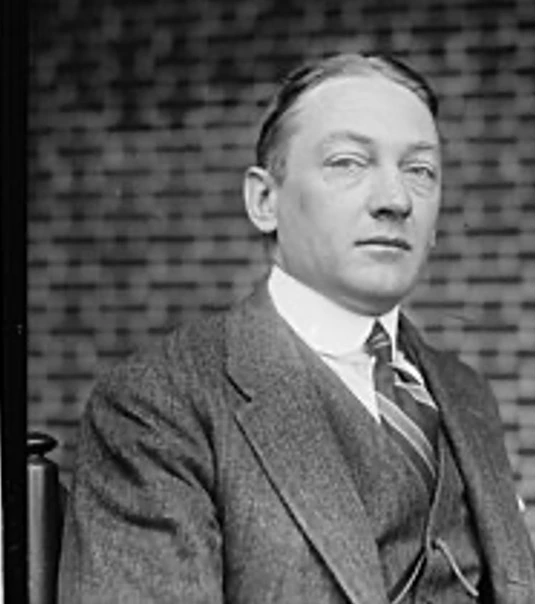
SWEETSER, Arthur
American reporter and Acting Director of the League of Nations Information Section in 1933
By Bob Reinalda · Version 13 July 2026
Was born 16 July 1888 in Boston, Massachusetts, United States and passed away 20 January 1968 in Washington DC. He was a son of Edward Mumford Fowler Sweetser, newspaper editor and publisher, and Edith Ashton Balch. On 19 June 1915 he married Ruth Gregory, with whom he had two daughters and three sons.
Biography
Sweetser grew up in Boston in a middle-class family that valued travel. His father wrote guidebooks and an uncle was a shipping broker. Sweetser attended the prestigious Boston Latin School and graduated from Harvard University, where he studied general arts and sciences, with a Bachelor of Arts in 1911 and a Master of Arts in 1912. He partly financed his studies by editing the university’s student newspaper The Harvard Crimson. Sweetser did an apprenticeship in journalism at the Springfield Republican in 1912 and 1913. When the First World War broke out in 1914, he set off for Europe as an Associated Press war correspondent, crossing frontlines in Belgium and France on a bicycle and being arrested several times by both French and German troops. He returned to the United States (US) in 1915 and published Roadside Glimpses of the Great War (1916), which was based on first-hand experiences and included a description of the First Battle of the Marne from both sides. He then covered the State Department for Associated Press and later entered the US Signal Corps Aviation Section as a captain which resulted in The American Air Service (1919), a publication about the significance of air power.
After the November 1918 Armistice Sweetser returned to France as a freelance reporter, writing for The New Republic and a naval trade journal. He profited from his State Department relations, when Ray Baker, advocate of US President Woodrow Wilson’s ideas about world peace, engaged him as an Assistant Director of the Press Section of the American Commission to Negotiate Peace. During the 1919 peace negotiations in Paris Baker left it to Sweetser to conduct relations with the American press corps and prepare special briefings. In early May Sweetser attracted attention with his clear summary of the draft Treaty of Versailles. Later that month Wilson’s political advisor, Edward House, nominated Sweetser as a member of the preparatory body of the League of Nations in London that was to set up an information section. Sweetser began his work in London with League Secretary-General Eric Drummond in July. In September the US Department of State accepted Sweetser’s appointment to the League’s Information Section that was starting to take shape and in October Sweetser helped organize the first International Labour Conference in the Pan-American Union Building in Washington DC. When President Wilson, the League’s primary architect, failed to take US Senators’ concerns regarding the Treaty of Versailles into account, the Senate rejected ratifying the Treaty that formally ended the war. This meant that the US did not become a League of Nations member, although a few Americans remained in Geneva, Switzerland, to serve the institution, including Sweetser, who stayed as a member of the Secretariat until 1942, ‘a tenure equalled in length by very few League officials’ (Ranshofen-Wertheimer 1945: 362).
Although Sweetser was a member of the League’s Information Section, led by French journalist Pierre Comert until the end of 1932, he worked at the Secretary-General’s office, often acting as Drummond’s personal advisor. Comert and Sweetser shared an international career in journalism, with Sweetser becoming the Information Section’s second-in-command. He published numerous articles and books about the League’s methods and performance, such as The League of Nations at Work (1920) and The First Ten Years of the League of Nations (1930). As an experienced journalist he guaranteed ‘constant press coverage of decisions taken by the General Assembly, the Council, the sections of the International Secretariat and the committees of experts’. At the time this openness and public reporting were unusual, because members of the Information Section were ‘outsiders to established diplomatic networks’ between states. They acted in line with Wilsonian ideals of open diplomacy but had to ‘invent the very means and procedures of public diplomacy’, according to Herren and Löhr (2018: 539). They managed to do so by establishing their own political networks and by relying on other sources of information that enabled them to have access to flows of information beyond the national spheres of influence. In 1925 the Assembly allowed the Section to hire interns from pro-League countries to educate them about the workings of the organization. Sweetser used the term ‘cooperative publicity’ for the liaison between the Information Section and private international associations. This connection was the responsibility of Section member Princess Gabrielle Radziwill. Sweetser also thought international education would encourage cooperation between states. Together with Ludwik Rajchman, Director of the League’s Health Organization, Fernand Maurette, economist at the International Labour Office and their three wives, Sweetser helped establish the International School of Geneva in 1924, designed to accommodate the children of diplomats and others. He acted as the school treasurer while his wife, a Chicago heiress, her mother and grandmother were key donors to the school, helping to secure its financial health in its first two decades.
Given his close relations with the Department of State in Washington DC and his convictions of peace making through international cooperation, Sweetser became an informal and efficacious liaison officer with the US. He played a special role by paving the way for ‘Washington-Geneva cooperation in a mounting number of nonpolitical activities’, in which the League was also very active (Donnelly 1983: 707). Sweetser maintained his contacts with American politicians, civil servants, journalists and intellectuals. His American friend Raymond Fosdick, briefly Deputy Secretary-General during the League’s beginning, introduced him to John Rockefeller, who then donated two million dollars to expand the League’s library in 1927. Sweetser met with representatives of the Rockefeller Foundation, which also financially supported Rajchman’s Health Organization, and the Carnegie Endowment for International Peace in Paris. He used his networks and mediated in projects for scholarly research and property acquisition by the League. When Japan attacked Manchuria in September 1931 the League Council kept the US informed about the Sino-Japanese War, although the US government refused to participate in the League’s commission of inquiry. But since Japan’s aggression affected American interests, it brought the US briefly (and for the only time) to the Council’s political negotiations in October 1931, which was not welcomed by isolationist American public opinion. Sweetser worked to coordinate the US Consul’s appearances at the Council table and to handle reports and other liaison matters for the US Ambassador during the November-December Council session in Paris. On this issue the US influenced the League, since the American non-recognition of Manchuria as an independent state later became a League principle. Sweetser was also influential in taking Harvey Bundy, US Assistant Secretary of State, to London where he introduced him to Alexander Loveday, Director of the Financial, Economic and Intelligence Section, who was responsible for organizing the League’s Economic Conference (London, June 1933), in which the US participated. But Sweetser was less successful when the new Franklin Roosevelt administration considered the appointment of a high-ranking emissary to the League in 1933. The plan failed, due to premature disclosures in the press because of Sweetser’s characteristic openness to journalists.
During his entire career at the League, Sweetser received a stable salary as member of the Information Section. His wife provided the financial means to maintain an elaborate home near Geneva, where they entertained American and other visitors. Sweetser’s effort to be formally promoted to Assistant Director of the Information Section in 1929 failed, as he was appointed to the Section as journalist and internal staff regulations, strictly organized along national lines (the Information Section being the only Secretariat section that appointed members on their nationality in order to maintain a balance between the great powers), did not allow him such a promotion. Sweetser’s proposal to establish a new Secretariat section, headed by himself, to foster liaison activities with a growing number of non-member states in the League’s non-political bodies failed on similar (and political) grounds. Sweetser, however, was given the honorary title of Counsellor in 1930. The Information Section employed about a dozen officials in 1920. The number increased to nineteen in 1932, representing seventeen different nationalities. The Section’s activities, including Sweetser’s informal liaison accomplishments, were widely appreciated, both internally and externally. In 1932, however, Director Comert was pressured to resign by Germany which wanted less French influence in the Secretariat and disliked Comert’s faith in liberal internationalism. After his resignation Comert worked for the French Foreign Ministry, while Sweetser became Acting Director of the Information Section during 1933, the year when the Section was subjected to organizational changes. The Assembly’s attitude towards the Section had changed, due to the League’s weaker position in international relations, the political upheaval in Europe and the question whether the organization should spend much money on information. The Assembly reduced the Section’s budget and halved its staff. Adrian Pelt, Section member since 1920 and its new Director in 1934, had to implement the reorganization. He came from the Netherlands, a small neutral country, and was appreciated for his knowledge of new technologies like broadcasting (Seidenfaden in Gram-Skjoldager et al. 2020: 132-133). Sweetser was removed from the Section, which was discouraged from liaising with private associations. The Section also lost its mandate to pursue political liaisons, the other of two elements close to Sweetser’s heart. Instead, the Section should focus on ‘its role as a press service, on releasing purely “factual” publications and on disseminating information through its nascent radio service’ (Seidenfaden 2024: 95). Sweetser became a special kind of Director, affiliated to Secretariat leadership but without section.
As late as 1933 Sweetser, Pelt and others tried to retain as many functions of the Information Section as possible through a committee and a report, but the new French Secretary-General Joseph Avenol continued the reorganization the following year. The reduced Information Section managed to retain several functions but became subject to oversight by other sections. All sections had to provide Avenol with monthly summaries of their work. While the use of photos, films and thematic pamphlets diminished, the Section maintained its information functions, also with weekly broadcasts, but with fewer journalists. Sweetser, no longer a Section member, acted as rapporteur and did pursue his liaison with the US. When the League’s new building, the Palais des Nations, was finished in 1936 he promoted tourism to Geneva by facilitating visits to the building by educated Americans and others. In 1939 he promoted the League of Nations in the US by installing a League of Nations exhibition pavilion at the New York World’s Fair. When Sweetser interviewed Roosevelt in 1938, Roosevelt advised the League to abandon its political activities, disband the Council and concentrate on non-political activities. Regardless of the value of this advice, the last element mattered for Sweetser a few years later.
Sweetser survived the 1938 reduction of League personnel, but with the German invasion of Western Europe in May 1940 Avenol reduced Sweetser’s status from full-time official to part-time liaison officer. Fearing a German invasion of Switzerland, Sweetser thought about bringing part of the League Secretariat to the US, a move not favoured by Avenol. Sweetser nonetheless used his contacts to accomplish this. In June the University of Princeton and the Rockefeller Foundation (headed by Fosdick) invited the League’s Economic, Financial and Transport Section (as it was called then, led by Loveday) to Princeton, New Jersey. After Avenol’s resignation in August the new British Secretary-General Seán Lester supported Sweetser’s American plan. That month some forty staff as well as important economic and statistical files left for Princeton, where the ‘Princeton Mission’ continued its work on the Allied side. Both Comert and Pelt managed to reach London, where they approached Drummond to form the ‘London Group’. They performed information activities on the Allied side, corresponded with Sweetser and provided their London Report about the administrative experience of the League in 1944. Sweetser and his family left Geneva in May 1940 and travelled via Italy to the US, where Sweetser worked with the Princeton Mission, staying in contact with Lester in Geneva. Sweetser supported the idea of encouraging the re-establishment of an international peace organization according to League principles but avoided using the name of the League in promoting his ideas in the US. In May 1942 he returned to national service, becoming Deputy Director of the Office of War Information (OWI) in Washington DC, set up by Roosevelt. His employment with the League ended in December that year.
OWI allowed Sweetser to network in Princeton and Washington DC, also using his position in private associations, such as his presidency of the Woodrow Wilson Foundation (1942-1945). In 1942 he was elected Chairman of the British-led Inter-Allied Information Committee, which he brought under the auspices of the American-led United Nations Information Office. This body coordinated between the Allies and was the first institution using the name United Nations (UN). Sweetser kept his League experience in mind but avoided any mention of it and to maintain manoeuvring room to network he made sure OWI kept its distance from other institutions. OWI assigned him with the task of coordinating the Allied powers, including their post-war plans, and of being the liaison with the Department of State. However, the Department did not welcome him as it made its own UN planning effort. Yet, when the Department approached Sweetser for names of people with international experience in 1943, Sweetser answered, but avoided well-known League names and mentioned names of technical experts only. His list was ‘Anglo-Saxon, European (with two exceptions), and male’ (Herren and Löhr 2018: 544). Sweetser was engaged in the London Draft of the later UN Charter and was a delegate at the founding of the United Nations Relief and Rehabilitation Administration in 1943, the Bretton Woods Conference in 1944 and the San Francisco Conference, where the UN was established in 1945. Although appointed as an OWI official in the US delegation, the Conference Secretariat led by Alger Hiss of the State Department did not consult him. Sweetser protested when Lester and other former League delegates, who had been officially invited by the US government, were not given seats. This resulted in seats being put in a back corner of the conference room. Sweetser’s effort to arrange sessions with the former League officials failed. Edward Stettinus, Chairman of the US delegation, explained to him that the US regarded them as participants with unofficial status.
In 1946 Sweetser resigned from OWI and was appointed special advisor to Trygve Lie, the first UN Secretary-General, although he was not given a post commensurate with his seniority. In the UN he met Pelt again, who was Lie’s Assistant Secretary-General. As Director of the UN’s Washington Information Office Sweetser worked tirelessly to publicize the UN. He retired in 1953. He helped to finance Frank Walter’s history of the League (published in 1950) and Paul Mantoux’s proceedings of the 1919 Paris Peace Conference (published in 1964). In 1954 he was founder of the International Schools Foundation for the education of American children abroad and in 1956 he took part in the presidential commission that observed the centennial of Wilson’s birth. Sweetser died in 1968. His remarkable career at the League of Nations Information Section was continued in the US during the Second World War but did not find much recognition in the UN. When the League was dissolved in April 1946 he said in his speech: ‘I feel a bit like a man on his second honeymoon who is asked to speak about his first wife’ (Mumby 2024: 41).
Archives
- Arthur Sweetser in League of Nations Archives, see https://archives.ungeneva.org/informationobject/browse?topLod=0&sort=relevance&query=Arthur+Sweetser
- Arthur Sweetser Papers in Manuscript Division, Library of Congress, Washington DC (Finding Aid 2023, see https://lccn.loc.gov/mm78042085)
- ‘Sweetser, Arthur, 1919-1924’ and ‘1924-1950’ in Raymond Blaine Fosdick Papers, MC055, in Princeton University Library, Princeton, NJ
- ‘League of Nations – Correspondence with Arthur Sweetser, 1940-1941’ in Institute for Advanced Study, Princeton, NJ
Publications
- Roadside Glimpses of the Great War, New York 1916
- The American Air Service: A Record of its Problems, its Difficulties, its Failures, and its Final Achievements, New York 1919
- Opportunities in Aviation, New York 1920 (with G. Lamont)
- The League of Nations at Work, New York 1920 (reprint 2023)
- ‘The First Year and a Half of the League of Nations’ in Annals of the American Academy of Political and Social Science, 96, 1921, 21-30
- What the League of Nations Has Done, New York 1922
- ‘What the League of Nations Has Accomplished’ in Current History, 16/6, September 1922, 995-1005
- What the League of Nations Has Accomplished, New York 1924
- ‘The League of Nations Month by Month’ in Current History, 27/3, December 1927, 410-413 and 27/4, January 1928, 569-570
- The Approach to World Unity, 1914-1919, 1920-1930, Geneva 1929
- The Practical Working of the League of Nations: A Concrete Example, Worcester 1929
- ‘The First Ten Years of the League of Nations’ in International Conciliation, 256, 1930, 1-60
- The First Ten Years of the League of Nations, Worcester 1930
- The United States and the League, the Labour Organisation, and the World Court during 1940, Geneva 1940
- ‘The Non-Political Achievements of the League of Nations’ in Foreign Affairs, 19/1, October 1940, 179-192
- ‘America Seen From Abroad’ in The Annals of the American Academy of Political and Social Science, 216/1, July 1941, 140-149
- ‘The United States and World Organization in 1940’ in International Conciliation, 372 , September 1941, 593-613
- The League of Nations in World Politics, Washington DC 1942
- ‘The League of Nations and Associated Agencies’ in International Conciliation, 397, February 1944, 140-149
- ‘Comments on Dumbarton Oaks’ in World Affairs, 107/4, December 1944, 252-253
- ‘The United States and World Organization in 1944’ in International Conciliation, 409, March 1945, 195-202
- ‘The World’s Civil Service’ in Iowa Law Review, 30/4, May 1945, 478-488
- ‘The United States, the United Nations and the League of Nations’ in International Conciliation, 418, February 1946, 51-59
- ‘From the League to the United Nations’ in Annals of the American Academy of Political and Social Science, 246, July 1946, 1-8
- ‘Perspective on the United Nations’ in World Affairs, 115/3, Fall 1952, 71-73
Literature
- H.E. Davis, Pioneers in World Order: An American Appraisal of the League of Nations, New York 1945
- E.F. Ranshofen-Wertheimer, The International Secretariat: A Great Experiment in International Administration, Washington 1945
- F.P. Walters, A History of the League of Nations, Westport 1950
- ‘Arthur Sweetser, 79, Is Dead
- U.S. Aid at U.N. and League’ in The New York Times, 21 January 1968
- The Washington Post, 21 January 1968
- J. Barros, Betrayal From Within: Joseph Avenol, Secretary-General of the League of Nations, 1933-1940, New Haven 1969
- T.L. Deibel, Struggle for Cooperation: The League of Nations Secretariat and Pro-League Internationalism in the United States, 1919-1924, Geneva 1970 (unpublished thesis)
- J. Barros, Office Without Power: Secretary-General Sir Eric Drummond 1919-1933, Oxford 1979
- J.B. Donnelly, ‘Sweetser, Arthur’ in W.F. Kuehl (Ed.), Biographical Dictionary of Internationalists, Westport 1983, 706-708
- F. Moorhouse, Grand Days, Sydney 1993
- M.A. Balinska, For the Good of Humanity: Ludwik Rajchman Medical Statesman, Budapest 1995
- S. Sweetser Clifford, One Shining Hour, New York 2005
- K.E. Rietzler, American Foundations and the ‘Scientific Study’ of International Relations in Europe, 1910-1940, London 2009
- D. Gorman, The Emergence of International Society in the 1920s, Cambridge 2012
- M. Housden, The League of Nations and the Organisation of Peace, Harlow 2012
- M. Mazower, Governing the World: The History of an Idea, New York 2012
- P. Clavin, Securing the World Economy: The Reinvention of the League of Nations, 1920-1946, Oxford 2013
- D. Plesch and T.G. Weiss, Wartime Origins and the Future United Nations, London 2015
- ‘Arthur Sweetser: The League of Nations at Work’ in Ecolint, 12 July 2016, see https://alumni.ecolint.net/authors/arthursweetser.html
- M. Herren and I. Löhr, ‘Being International in Times of War: Arthur Sweetser and the Shifting of the League of Nations to the United Nations’ in European Review of History, 25/3-4, 2018, 535-552
- H.A. Ikonomou and K. Gram-Skjoldager (Eds), The League of Nations: Perspectives from the Past, Aarhus 2019
- D. Macfadyen et al., Eric Drummond and his Legacies: The League of Nations and the Beginnings of Global Governance, Cham 2019
- G. Scott-Smith, ‘A Transition of Internationalisms: Britain, the United States, and the Formation of the United Nations Information Organization during World War II’ in International Journal for History, Culture and Modernity, 7, 1-23
- K. Gram-Skjoldager, H.A. Ikonomou and T. Kahlert (Eds), Organizing the 20th-Century World: International Organization and the Emergence of International Public Administration, London 2020
- A. Rodriguez-Giovo, ‘Our Debt to Arthur Sweetser’ in Echo Magazine, 27, Winter 2022, 15-17
- J. Mumby, Dismantling the League of Nations: The Quiet Death of an International Organization, 1945-8, London 2024
- E.E. Seidenfaden, Informing Interwar Internationalism: The Information Strategies of the League of Nations, London 2024
(all websites accessed on 21 January 2026)
How to cite
Bob Reinalda, 'Sweetser, Arthur' in IO BIO, Biographical Dictionary of Secretaries-General of International Organizations , edited by Bob Reinalda, Kent J. Kille and Jaci L. Eisenberg. https://sandbox.zenodo.org/records/604358 (sandbox preview)
Text © the author(s) and IO BIO, licensed under CC BY-NC-ND 4.0. The portrait is excluded and remains under the rights of its credited source. We have tried to trace the rights holder to obtain permission for the use of the portrait, but contact us in case we have failed.